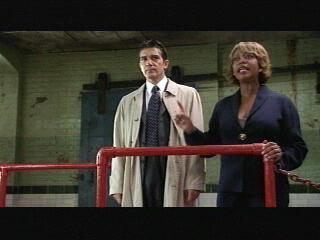
1973 - when I started asking questions, like, "Why are we all dressed so funny?"
Showing posts with label Film. Show all posts

Thursday, April 23, 2020

The USA in "Us"?

Us Movie Explained - What Jeremiah 11 11 Means in Us Movie

Envy, Resentment - Oh, My!

Intended or not, Jordan Peele's Us (2019) subtly rejects the politics of envy by highlighting the fact that the socially and economically aggrieved may know what's owed them but may very well lack the capacity to build anything. 

The film begins with an affluent African American family heading on vacation to some locale near Santa Cruz, CA. Despite the mother's early childhood trauma, the family appears to be the very picture of the American Dream: wealth, status and a couple of relatively normal kids. Alas, all is not well in Paradise. It turns out that each member of the family has his very own doppelganger dressed in red coveralls and armed with shiny, soon to be glistening, scissors. 

The paired families consist of Adelaide-Red (mom), Gabe-Abraham (dad), Zora-Umbrae (sister), and Jason-Pluto (brother). After letting themselves in (against the will of the Wilsons), Red laboriously and laconically lectures everyone about how (1) each is tethered or connected to the other, (2) life is really bad downstairs in the underworld, and (3) some human though certainly not humane power has made each sunshine suburbanite paired  to a downcast, demented demoniac. 

The good news is that the Fabian Four are "Americans"; the bad news is that momma bear has been hearing God's voice (this usually does not end well in a horror movie) and the voice tells her that happiness and freedom can be obtained only by slicing and dicing their betters (Red calls this "untethering" but the less morally obtuse might just term it "murder"). To go from bad to worse, it turns out these folks who self-identify as Americans have no desire to pull themselves up by their sandal straps but to prosper by displacing-by-death the very decent and upright people who made America great.

I'm reminded here of some of the words found in the title track of Black Sabbath's Heaven and Hell (1980; twenty years young this year): 
Do me a wrong, you're a bringer of evil.
The Devil is never a maker.
The less that you give, you're a taker. 
Like the Devil, these dread doppelgangen build nothing, life lifelessly and are propelled by rage's resentment. Not an attractive group.

Lifestyles of the Rich and Famous - Wikipedia

Cheers, I owe you!

Are the gated communities of America's rich, prosperous and famous made possible because of the suffering and degradation of a permanent underclass? Did Gabe attend Howard University on the back of Amblin' Abe? Did Zora's neglect of cross country running and love of electronics make Umbrae the fleet-footed loonie she became? 

Peele does not provide answers but his film illustrates nicely is that without a positive proposal for living life, one can easily fall into comparing one's life with that of others and grasping for the Good at the expense of another. In biblical language this is called covetousness, and it leads only to resentment, envy and pain. And perhaps a raw rabbit or two. 

Tuesday, July 31, 2018

Some Big Ideas for Little People

Downsizing


Image result for downsizing

Scanning the reviews on IMdB one notices a wide-range of opinions from 1/10 to 10/10, which can be a sign that a film has - at least - potential. This is a film with potential but is definitely not for everyone. 

I had expected a more dystopian angle: the noble goal of saving the resources of the planet by reducing everyone down to roughly six inches tall is certainly a recipe for the powers that be to oppress by compression on a global scale. The political abuses are an important part of the story in the character of Ngoc Lan Tran (Hung Chau) who is shrunken against her will by the communists in Vietnam but the abuses are not a major part of the story.

The scenario is this: in the future scientists discover a way to reduce any organic matter to a fraction of its original size. The benefits for economizing on existing resources are terrific: one could make a saltine cracker last for months. The economics are also tantalizing. For Paul (Matt Damon) and Audrey (Kristen Wiig) they can get a dream home and comfortably retire at a small-person paradise called "Leisureland," just by selling their existing home. It sounds too good to be true, and when Paul opts to proceed with the shrinky-dink procedure, Audrey backs out without Paul's knowledge -- leaving him stuck without a spouse and stuck with a penurious divorce.

Paul finds himself working at a call center for Land's End and near the end of his rope in Leisureland without a whole lot of leisure. When things don't work out with a single mum, Paul reluctantly accepts an invitation from his playboy neighbor Dusan (Christoph Waltz) to let his hair down. This leads Paul to a night of excess and later meeting the aforementioned Ngoc Lan Tran who escaped Vietnam via a TV box but lost her foot. Paul finds himself commandeered by Tran who is a lady who will not take No for an answer: Paul is shanghaied to help Tran's dying room-mate and repair Tran's prosthesis which he breaks and finds himself working for her to pay off the debt. 

Dusan looks with pity at Paul's decline in fortunes and suggests Paul join him in a smuggling operation to the original tiny guy colony in Scandinavia. Tran insists that she join him. The northern Europeans have science on their side and have become convinced that THE END has come for planet Earth. They scurry down a rabbit hole and Paul is tempted to join them. However his affection for Tran overcomes his instinct for self-preservation. 

Dusan notes that the Swedes have been hollering about a global catastrophe for years and well, so far, so good! Paul returns with Tran and he spends his days helping the poor in Leisureland's ghetto. 

Image result for downsizing damon chau

While the film is unsure which direction it wants to take (satire, social criticism, comedy, drama...), it ends on a very interesting note: the secular northern Europeans are sharply contrasted with the religiously inclined poor living in the shadows of prosperity. Paul's decision to stay with the poor despite the uncertainty suggests a subtle but powerful critique of the view that technology, science and consumerism can save us. In the words of Tran: See, Paul? Jesus smile for me. Indeed He does.
Read more: https://www.springfieldspringfield.co.uk/movie_script.php?movie=downsizing

Monday, July 09, 2018

Finding "Equilibrium"


Image result for equilibrium film

Equilibrium, Dir. Kurt Wimmer, 2002

Not a Matrix knock-off

Despite the obvious marketing pitch, this film shares almost nothing in common with The Matrix. That doesn't make for a deeply original film regarding source material, but it is still original in the way it plays with the dystopian genre and pay homage to many classics in the literary canon.

All totalitarian systems promise to eliminate a serious problem, whether it be the oppression unleashed by the greedy capitalists in Marxism or the elevation of Nation or People in fascism. The lesson of history is that these "solutions" always and everywhere bring their own brutalizing consequences. 

The new world order that emerges from the ashes of World War III is Libria. The leader of this Calm New World is named "Father" whose politburo is the Tetragrammaton Council. For Jews and Christians the Tetragrammaton -- YHWH -- is the four letters in Hebrew that denote the divine name, but this unheavenly Father seeks humanity's abasement, not their good. 

Society's new configuration is justified by appeal to solving the root causes of war: hate, envy, rage. The method is found in Prozium, a drug which gives everyone a kind of creepy affect of total calm. Neither happy nor sad, merely robotic. Naturally, the elimination of negative emotions lead to the suppression of the good ones such as love and empathy or for an appreciation of beauty. 

Emotions thus become identified as the great defect (some would say our Sin) but better living through chemistry takes away all the bad. Also taken away is a rationale for living. This bit of dialogue captures well the Faustian bargain:
Mary (Emily Watson): Let me ask you something. [Grabs his hand] Why are you alive?
John Preston (Christian Bale): [Breaks free] I'm alive... I live... to safeguard the continuity of this great society. To serve Libria.
Mary: It's circular. You exist to continue your existence. What's the point?
John Preston: What's the point of your existence?
Mary: To feel. 'Cause you've never done it, you can never know it. But it's as vital as breath. And without it, without love, without anger, without sorrow, breath is just a clock... ticking.
Mary (Emily Watson) surnamed O'Brien in what can only be a nod to George Orwell's Nineteen Eighty-four) may have a rather impoverished view of life's horizon's but compared to the cold logic of Libria's powers-that-be, her desire grasps for the infinite.

The Grammaton Cleric John Preston will soon be aiding the "sense-offenders" who deliberately stay off their meds to enjoy things such as literature, poetry and art. He is not the only one of the enforcers of the status quo who begins to question. His partner Partridge (Sean Bean) has been off his meds for some time but raises John's suspicions early on in the film when he snags a collection of Yeats' poems and implies that perhaps their work is not as blameless as it seems.

Image result for equilibrium film partridge

Being a good (that is, fully-medicated) Cleric enables John Preston to kill his partner without blinking. But accidentally skipping a dose of Prozium gives him the opportunity to feel the sheer awfulness of that act and recall his previous blithe acceptance of his wife's arrest and execution for similar "sense-crimes." His lapse from his meds opens up a new world and he begins questioning the system he serves.

Besides the aforementioned Orwell classic, there is also a bit of Ray Bradbury's Fahrenheit 451 inasmuch as the preferred method of destruction for books, art and music is a flamethrower. The "Mona Lisa" is consigned to the flames without a flicker of regret.

Aldous Huxley's Brave New World is only slightly present but in an important premise of the film: drugs can form the very foundation of order in society (in BNW Soma serves to flatten the occasional hiccup that the genetically predetermined people experience in their suppressed but still-human consciousness; in Equilibrium drugs are THE solution, not eugenics).

Like good B-movies of old, the good guys win and the evil system is taken down. They may not live happily ever after but they'll face their future in a human way.

Best dialogue: "It is not the message; it is our obedience to it..."

Worth watching and serves as an invitation to deeper and more compelling works by Huxley, Orwell, Bradbury and others.


Sunday, June 24, 2018

Total Recall, Total Dud


Image result for total recall 2070 movie

Dudley Done Wrong

Total Recall 2070. Directed by Art Monterastelli, performances by Michael Easton, Karl Pruner, and      Cynthia Preston, Alliance Atlantis, 1999

Stylized and cribbed from Blade Runner down to the Asian style among the denizens of an unnamed city, a synth-pop knock-off of Vangelis and a purposeless "Gaff" (James Edward Olmos) clone, Total Recall 2070 also steals the basic plot of a most excellent movie. This is not that movie.

In this movie, self-aware androids want more time to -- have memories -- and thus snatch a Rekall Corp. scientist but are thwarted by our hero, David "I Kid You Not" Hume (Michael Easton) who must have been a stunt double for David Duchovny at some point in his career. The androids are sneaky and end up grabbing the Mars-bound scientist in order to hold onto their precious yet fake memories and feelings.

Meanwhile a youngster who is a mind-reader (this is the future and radiation does great things in the future) and most excellent video game player is kidnapped from two distraught foreigners with the surname of Bimboo or Sordoo or Sodoor or somesuch. This sad couple mistakenly thought they went for a nice trip to the Galapagos Islands but really had a mind-job done on them by Rekall (or someone pretending to be a Rekall rep) and had their kid snatched along with any memory of even ever having a kid. What a nasty corporation!

No new ground is covered in the pilot but there are no less than three zingers that will give viewers a chuckle and/or a deep sigh:

Image result for commander data

1. After our protagonist, good cop, Officer Hume loses his partner in a gun-battle with androids, he gets a new partner with the personality of Lieutenant Commander Data from Star Trek the Next Generation but has no clue that this cop is - gasp! - an android. I'm a complete space cadet and it was clear to me from the first scene with Mr. Roboto and his "Caesar" haircut that this was a tin man. Remember, Hume's whole professional life revolves around paying attention to what's going on.

Image result for dirty harry

2. Much ado is made of the lethality of a 12mm pistol that Officer Hume has snatched from the scene of his partner's murder, but when he deploys the weapon he is (a) unable to hit the back side of a barn with it, and (b) when he randomly does hit his target, the victim dies no more surely or not than the bodies that seem to fall everywhere from ray guns in the hands of most everyone. 

Image result for scarlett o'hara

3. Hume's highly principled and loyal wife, Olivia, is often on the verge of getting really, really mad with David but she always falls back and melts in his arms, and supports all of his crazy antics in the end such as going to Mars with his robotic Lurch-like partner.

This one was bad. Unfortunately is was not bad enough to be bad like Sharknado. I give it two out of five velotaxis. 

Image result for bicycle blade runner


Sunday, July 17, 2016

"B" movie, "A" content: Seeking a Friend for the End of the World

G.K. Chesterton was of course right when observed (I think it was in What's Wrong with the World?) that "if it's worth doing, it's worth doing poorly." Some films are not exemplary in terms of production values, acting, and all the other goodies but they did some things well.

Today's example:

Seeking a Friend for the End of the World was surprisingly warm and gentle for a film dealing with the moral catastrophe that precedes the extinction of the human race. It is a bit surreal when amid the debauchery and mayhem, much goes on as usual. For example, when the unlikely yet strangely likable couple, Dodge (Steve Carell) and Penny (Kiera Knightley) get a bite to eat at the local "Friendsies" restaurant, the staff is warmer than ever and intoxicants flow freely, but no one seems all that concerned about the impending crack of doom. Alas, death (thankfully) is not the point of the film. The point is living life. Not living life at the level of an abstraction but with immediacy with what and who is front of you. Yes, it is a bit creepy when the inevitable relationship that grows between Dodge and Penny does flourish, but it also rings true and somehow right. Dodge gives up the quest for finding his high school sweetheart when he realizes he's chasing an illusion. Penny for all her flaws is real. She is present. The film is not a "realistic" end of the world set-piece, nor is it a romantic comedy. It is more appropriately a meditation on living morally and humanely while everything else comes crashing down.

Chesterton noted that what was wrong with the world was himself, thus pointing to the fact of Original Sin. He surely would have appreciated the paradox that what is wrong with the world is also what is so, so right with the world: human beings.

Monday, January 11, 2016

The Way Back

The Way Back 

Director Peter Weir has taken a controversial book and made a great film. The book is The Long Walk by Slavomir Rawicz. The Way Back is inspired by the book but does not pretend to be a "based on a true story" kind of film because it cannot be verified that what the Polish author (who was indeed imprisoned by the Soviets) actually made the journey or if someone else did or whether it happened at all. There seems to be evidence that something did happen along the lines of escaped prisoner trekking from Siberia to India during the Second World War.

This is a film that probably can be used in the form of film clips but would not justify viewing the entire film for the purposes of understanding Stalin and his particular form of evil. But it is a great film for understanding that the weakness of kindness can actually be a strength that restores humanity to a person.


Enter Irena 

Derived from the name of a Greek pagan goddess of peace, Irena does bring peace but also an opportunity for the characters to grow more human. Irena tells a tale of being a farm girl who witnesses the murder of her parents at the hands of the Soviets and is then sent for work on a collectivized farm. She escapes. Mr. Smith puts her story to the test by Irena's improbable geography. The truth is, her parents were Polish communists who emigrated to Russia during the salad days of the post-Revolution period but are later arrested by Stalin's regime. Irena is placed in an orphanage.

Irena serves as a bridge between the men, allowing their own crimes and evil to rise to the surface. The admission of the past is not something that destroys them but serves as an opportunity for grace and forgiveness. She exhibits the feminine genius of at once disarming and empowering men to be more themselves.

For how she does it one must watch the film.

Saturday, January 09, 2016

"The Hunt"

The Hunt

Mads Mikkelson (who was just fantastic in the hilarious, profound and scary Adam's Apples) plays a teacher in The Hunt who has taken a job at a kindergarten because the local school closed. He gets into a custody battle with his wife, starts falling in love and gets accused of inappropriate behavior with a child.

Any one who has been falsely accused will quickly identify with the protagonist. Scary, haunting but ultimately redemptive.

If I could create a genre for this film, I would call it epistemological: it asks to consider what we know and how we know it. It touches on several themes but does not conflate to a moral tale about the dangers of witch-hunts and hysteria, nor does it demonize those think Lucas (Mikkelson) guilty of the "crime." A very un-Hollywood kind of film. Friendship, family, love, hate ... it's all in there.

Mature theme with some sexuality (but pretty tame for the Swedes if those vicious stereotypes are true).

Thursday, December 03, 2015

Of Mice and Men (Film, 1992)

Gary Sinise retains the best of the dialogue and gently adapts the story on either end for cinematic purposes. John Malkovich is credible without being maudlin as Lenny, and Sinise does a fine job as George.

A change I didn't like was the substitution of the Luger for Colt or S&W .38. The Luger gave a dark undertone that American revolvers lack. (That's my biggest "complaint" for this fine film)


Sunday, November 01, 2015

Movie as Metaphor...for What Ails Education?

The Pentagon Wars is clearly a "B" movie, 

and a nearly humorless comedy at that, but that does not prevent it from having some explanatory power.

The movie is allegedly based on the book by a retired Air Force Colonel who wrote what looks like a serious and detailed study of bureaucratic malfeasance in the Pentagon's procurement process (James Burton, The Pentagon Wars: Reformers Challenge the Old Guard).

Stacked up against such notable classics as Catch-22 or Doctor Strangelove, it surely fails as a "military-lunacy-film," but it does score points in showing how idealists can get co-opted by the system or simply eliminated. The film does seem to leave open the possibility of a "third way" within the system in the character of one Colonel (later Brigadier General) Smith who feeds tidbits of truth to the press and Congress. Yet his timidity suggests this third way to be a compromise that one ought to not consider to remain morally coherent.

The Connection with Education...  

As he was near leaving office, President Eisenhower famously warned of the "military-industrial complex" which could lead to a consumeristic approach to the planning, production and acquisition of war materiel. The film demonstrates how some of the dynamics can work on a small scale. In this case, with the long drawn-out design and testing of what would (finally) become the Bradley Fighting Vehicle.

The education establishment does not consist of generals, but principals, superintendents, professors at schools of education, textbook publishers, lobbyists and politicians. The latter are in abundance and, while they cannot rival the Pentagon's annual budget, education policy and practice far outstrips any cultural contribution the military makes.

And rather than inflated weapons systems that get pushed into the pipeline and have a way of being refined one way or another, the educational schemes that emerge from the "educational-bureaucratic complex" seem to have less "quality assurance" than say, the M16 (one of the best moments of the film is when "Colonel Burton" tells the tale of Vietnam veteran he met who used on the early M16s with the cheap ammo that cost hundreds of lives in the early days of its fielding). When soldiers die, people begin the notice. When educational schemes fail, does anyone notice?


Sunday, October 18, 2015

DEATH SENTENCE - Almost as good as Sharknado!

Good Heavens!  Rating: 3 out of 5 amputations below the knee

Still of Kevin Bacon in Death Sentence (2007)
Where does one even begin? This is perhaps the funniest movie I've seen since Sharknado!  Granted, with the shark film, I had already braced myself for absurdity but with Death Sentence, I had no idea what kind of film I was getting myself into.

The premise is intriguing: a father witnesses his son getting killed in a random act of gang violence, and decides to take the law into his own hands. This could go in multiple directions, all of them interesting. Moral complexity? Well, the raw material is there but you won't find it here.

What you will find is Kevin Bacon as a kind of Clark Kent miraculously transformed into The Terminator. Professionally, he works for a corporation and seems to be responsible for -- risk management! The film is politely incoherent and all the bad guys get wiped-out (this was not a surprise once I realized the film was not serious).

Special effects are from the George Romero School of Film: a dead cop in the car who has a fountain of blood streaming from his neck; one gang member flies in the air 30' when a car hits him and he's doing just fine in the next scene; another gang guy loses the lower 2/3 of his leg below the knee after a blast from Bacon's 12 gauge shotgun in a moment that is reminiscent of the knight fighting scene from Monty Python's Holy Grail. Rich stuff.

The award for best contrived scene surely goes to the rooftop garage scene where Bacon wraps a seat-belt around a bad guy's neck and the car -- defying gravity as it propels itself up a slope! -- flies off the 3rd level and onto the ground. Sheesh, sometimes seat-belts don't save lives! 

There's also a great chase around the house almost as funny as Inspector Clouseau versus Cato in The Pink Panther Strikes Again. The highlight is when Bacon literally pulls the rug from under a bad guy right before he blasts him.

Best unfathomable moment is after Bacon has shot up the town and returns with his rat-scalped self to his now empty house (he has succeeding in getting his wife killed). The lady detective shows up with a convoy of cop cars to his house to ... tell him his remaining son is going to be okay! No arrest, no lecture about going on a killing spree, just good news. Holy Implausibility, Batman! 


Not to be missed: the scene where Bacon shaves his head badly and at the same time plays with various guns and ammo. It lasts about ten minutes but the haircut is worth every second.

Look, I know Kevin Bacon, John Goodman, and, yes, Renee Russo all need to make a living, but is this sort of thing really necessary.

Sunday, May 05, 2013

Deliver Us from "Freedom Writers"

http://content.internetvideoarchive.com/content/photos/849/035693_3.jpg Take the Lead
I went into this movie thinking it would be "pious claptrap" about the saintly teacher who selflessly gives of himself to save beleaguered inner city youth. Ugh, another Freedom Writers?, I thought. Or perhaps a film about a cranky old guy who receives a revelation from today's youth in which he ditches his ways for the "wisdom" of youngsters.   
Films of either genre make my skin crawl.

On the contrary! Although it has some "Oh, come on!" moments (alleged spontaneous dance moments that have been obviously choreographed to death, for example), Take the Lead has an amazing performance by Antonio Banderas who is willing to say (and live out the ideal), "Everyone is entitled to a little culture" (which, from his tradition is...ballroom dancing!).
Not only is "white privilege" not mocked nor scorned, but it is suggested that the ancient things just might have a role in education today. Utterly refreshing.

This film is a meditation on the evocative power of beauty, grace and tradition. Yes, you'll have to suffer from a bit of hip hop (or enjoy it immensely, as I don't).

Wow, perhaps adults do have something of value to pass on; something that does not depend on our effort to make everything "relevant" to kids. Some things, the things of the heart, are always and everywhere relevant for those with a beating heart and an open mind.
Summary: somewhat like Stand and Deliver meets Strictly Ballroom.

Sunday, April 21, 2013

The Holy Legion of Diana Moon Glampers

I came across an article in First Things that lamented the lack of substantive guidance concerning film found on the American bishops' website. For some reason this got me thinking of Diana Moon Glampers (the portly, matronly villain in Kurt Vonnegut's "Harrison Bergeron").

This story is common in public secondary schools here in the States, but in case you've forgotten the tale, here's the climax:

Harrison placed his big hands on the girl’s tiny waist, letting her sense the weightlessness that would soon be hers.  And then, in an explosion of joy and grace, into the air they sprang!

Not only were the laws of the land abandoned, but the law of gravity and the laws of motion as well.

They reeled, whirled, swiveled, flounced, capered, gamboled, and spun.

They leaped like deer on the moon.

The studio ceiling was thirty feet high, but each leap brought the dancers nearer to it.

It became their obvious intention to kiss the ceiling.

They kissed it.

And then, neutralizing gravity with love and pure will, they remained suspended in air inches below the ceiling, and they kissed each other for a long, long time.

It was then that Diana Moon Glampers, the Handicapper General, came into the studio with a double-barreled ten-gauge shotgun. She fired twice, and the Emperor and the Empress were dead before they hit the floor.
 Poor Ms. Glampers! As in her (future) day as today, people so often want the end without a messy means. In this story "we the people" want absolute equality and the enforcement mechanism is a horror.

The Legion of Deceny had the best of intentions: filth ran rampant in film (for the 20s and 30s, that is) and they created a simple rating system that was meant to protect pious hearts, minds and eyes from temptation. What has always made me curious about this approach is the censor (or "guidance counselor" if you prefer): how is he protected from the filth? Is he like an exorcist who has a designated role in which he gets special protection? In other words, doesn't the censor endanger his own soul?

In this I'm reminded of a friend who recounts that the private Christian school she went to had a cheer-leading squad. After each game, the principal and assistant principal (two white guys) would review footage of the girls performance to ensure that their short dresses were of appropriate length as they "reeled, whirled, swiveled, flounced, capered, gamboled, and spun." Yeah, protecting everyone's morals, I'm sure.
 
Censors of the soul (and body) are alive if not well. For all I know, they are legion.

Permission granted 

In film, fiction and other areas of creative expression, some look for someone else's permission to view or read certain works. I can sympathize with this at one level: in our hyperactive age, it seems that one simply doesn't have the time to judge for oneself. Alas, the price of the shortcut (trusting in the wisdom of the impeccably safe expert) is alienation. But wait, there's more: you also get absolution from responsibility engaging the world with all of its ambiguity. Disengagement is magically transformed into piety and virtue. I call that a bargain.

Without a willingness to take risks, it is impossible to mature. And maturing is simply the fruit of being edcuated - continually. I have had parents complain that the text I assigned or the film I showed was scandalous or too suggestive or simply "too confusing" for their son or daughter. I think they are often being a bit disengenous when they say this. For all I know, it's true: their son or daughter doesn't "get it," but the punchline is that neither does mom or dad. That's the real problem: mal-educated parents who are unwilling to try to understand.

I should note that in none of these cases did the works appeal to prurient interests nor did they contain an excess of nudity or gratuitous violence. I'm very circumspect in what I share with students.

So, what's going on here? Am I watching the "dumbing down of America" before my eyes?

My pet theory is that there are a lot of good, faithful Catholics who simply want to be spared the drama of interpretation. This is where the censors or gurus or experts come in: they certify content for us. Their slogan could be, "We think so you don't have to!"

T.S. Eliot warns of this pathology:

They constantly try to escape
From the darkness outside and within
By dreaming of systems so perfect that no one will need to be good (Choruses from "The Rock").
I don't think that Catholics in America are so obtuse that we need a revitalized Legion of Decency (such travesties can be entrusted to our evangelical friends!); what we need to do is to begin educating ourselves. In no little part, this is why the Church exists for us.