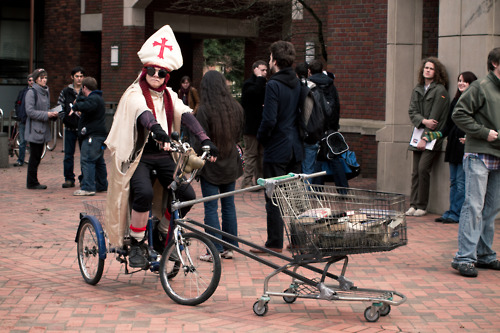
Narrow conceptions of reason have got us into all sorts of trouble, especially in American education. The idea of this site is to kick around ideas about education and compare ideas with experience. And, verily, to occasionally blow off steam.
1973 - when I started asking questions, like, "Why are we all dressed so funny?"
Monday, May 18, 2020
The Moviegoer: An Unauthorized Ending
Sunday, August 28, 2016
I'm a Simpleton. Are You a Simpleton?
In Walter Miller's tale, A Canticle for Leibowitz, there is a "great simplification" unleashed after a nuclear holocaust akin to Pol Pot's attack on the learned in Cambodia but world-wide in scope.
As I set sail for the year 1493 (that would be Chapter 2 in Loewen's Lies My Teacher Told Me), I feared I was headed for one of Miller's (in)famous Simple Towns where learning has stopped and simple explanations reign. In this I was disappointed that this was the case, but not surprised.
What was surprising was reading Loewen's unconscious mimicking of a the worst approaches to any subject: simplification to the point of distortion. One would think that Loewen would be astute enough to remove the lumber from his own self before railing against the textbooks but it was not to be.
The big question for people like Loewen who congratulate themselves for happening to have been born after the unenlightened hoardes who proceeded them is along these lines: So, are you suggesting that it would be better that you did not exist? According to your narrative, the world would have been better off if Columbus never set sail and history did not unfold as it did. Had it not, I dare say that none of us would be here opining about the crimes of others that we distance ourselves from.
Loewen would prefer a world where the weak are not trampled on by the strong and that is understandable, but that world does not exist. That does not mean sugar-coating the sins of our fathers, but it does mean recognizing that every group of people have done evil. Do you think the Aztecs would have shied away from slaughtering the Spaniards if they had the means to do so? Does a group of people achieve sinless status simply because they get exploited?
C'mon, virtue does follow simple because one has been victimized. Yes, high school history textbooks over-simplify and are vapid, but great books are not created by simply inverting the historical narrative.
Thursday, February 11, 2016
Bad Book, Good Effects
![]() |
| Spanish Male, ca. 15-16th Century |
Contrary to the "scientific" illusion, in the research and writing of history there are no final results. And the purpose of history is often not so much the definite accounting of the events of a period as it is the historical description and understanding of problems: description, rather than definition; understanding, rather than completeness -- because while a perfect completion of our knowledge of the past is not possible, a reasonable and proper understanding of it is within our powers (xii).
![]() |
| I think I can... |
Well, that's enough for now. The book to be written could be titled How to teach history even if you're stuck with a lousy anchor masquerading as a textbook or something similar.
Wednesday, February 10, 2016
Loewen's LIES
Monday, January 11, 2016
John Lukacs, A Short History of the Twentieth Century
Some samples:
The enormous events of the twentieth century, the two mountain ranges that largely determined its landscape, were the two world wars -- the Second largely a consequence of the First, and the so-called Cold War almost entirely a consequence of the Second (3).
Hatred is stronger than fear. ... But in the human world, hatred eventually becomes self-destructive; it does not always prevail in the long run, while fear often does. Still, this can be no consolation to those who either experience or comprehend the power of hatred over fear in the short run. Besides, hatred, even more than fear, may also involve participation: people hate what they hate in themselves, or they often hate who or what is close to them. What is vengeance but the wish to cause suffering in order to heal one's own suffering? "In the spirit of revolt," Georges Bernanos wrote, "there is a principle of hatred or contempt for mankind. I'm afraid that the rebel will never be capable of bearing as much love for those he loves as he bears hatred for those he hates" (53).
Enemies of Roosevelt would call these preliminaries to Pearl Harbor Roosevelt's "Back Door to War." That was a half-truth. What is true that throughout 1941, Roosevelt tried everything -- well almost everything -- to provoke a serious German attack on American warships in the Atlantic...(124).
Churchill. Surely we assess him by his consequences. He did not win the Second World War in 1945. But he was the one who, in 1940, did not lose it. Whence his historical grandeur. ... He foresaw, perhaps before anyone else, what Hitler meant (128-9).
One thing we may say in favor of Stalin: his ambitions -- contrary to the belief that was widely accepted for decades after the Second World War -- had their limits, not because of his modesty, of course, but probably because of his peasant-like realism (129).
Wednesday, December 30, 2015
A Book I'll (probably) Never Teach
Clearly Percy's darkest novel and most theologically daring. So, what's not to like? Why not teach it? Well, the immediate objection at the high school level is the sex. But that's just an obvious objection. The deeper problem is with the inability of the average student to even see what Percy is getting at. I got it (finally, after a much closer, second reading) and his point is well worth noticing:
1. The "go along, get along" nihilism of the super-majority who may not have the indecency to be lewd but worship lewdness at the altar of the Hollywood Stars. Then there are the hyper-sexualized Stars themselves who turn out to be utterly vacant. Some examples:
I looked at Maude in astonishment. Had everybody in this town gone nuts or was I missing something? The special nuttiness of movie people I was used to, but the town had gone nuts. Town folk, not just Maude, acted as if they lived out their lives in a dim charade, a shadow-play in which they were the shadows, and now all at once to have appear miraculously in their midst these resplendent larger-than-life beings. She, Maude, couldn't get over it: not only had they turned up in her library, burnishing the dim shelves with their golden light; she had for a moment been one of them! (Page 138, Ivy Books edition, 1993)
Dana was something to see: barefoot, tight jeans with silver conch belt, some kind of pullover homespun shirt, necklace with single jade stone, perfect helmet of yellow hair, perfect regular features, perfect straight brows flaring like wings. He moved well and had grace. He was a blank space filled in by somebody's else's idea. He was a good actor (133).
I didn't think Raine was wonderful. She was amazingly pretty, with a pure heart-shaped face and violet-cobalt eyes which seemed to look from her depths to yours, a trick I came to learn, that steady violet gaze, chin resting on the back of her bent hand. Her depths were vacant (100).2. The Neo-Stocism/Southern Ideal of Lancelot that is agnostic about God, Christ and love but certain of how to act. How to be in the world that is this corrupt:
I cannot tolerate this age. And I will not. I might have tolerated you and your Catholic Church, and even joined it, if you had remained true to yourself. Now you're part of the age. You've the same fleas as the dogs you've lain down with (144).
Then how shall be live if not with Christian love? One will work and take care of one's own, live and let live, and behave with decent respect towards others. If there cannot be love -- you call that love out there? -- there will be a tight-lipped courtesy between men. And chivalry toward women. Women must be saved from the whoredom they've chosen. Women will once again be strong and modest. Children will be merry because they will know what they are to do (145).
Which is worse, to die with T.J. Jackson at Chancellorsville or live with Johnny Carson in Burbank? (144)
If you were right, I could stand it. If your Christ were king and all that stuff you believe -- Christ, do you still believe it? -- were true, I could stand it.... I could live your way if it were true (140-141).
As is Percy's way, the novel ends on an ambiguous note (what will Lancelot in the end do with his life?), but what is clear (after my second reading; after my first, I was merely flummoxed) is that Father "Percival," the nearly voice-less listener to Lancelot's tale or confession, is converted by Lancelot's quest for evil, for sin. Lancelot alludes to Percival's lack of faith throughout the novel:
- There is only one way and we could have had it if you Catholics hadn't blown it: the old Catholic way. I Lancelot and you Percival, the only two to see the Grail if you recall. Did you find the Grail? You don't look like it (162).
- You don't even believe it yourself, do you? ... But if what you once believed were true, I could stand the way things are (140).
Percival, the priest-psychologist has lost his faith. Lancelot sets out to definitively prove the existence of evil/sin and thereby force the world to make sense, but in the end Lancelot cannot see it. Percival does. Some relevant passages:
- The truth is that during all the terrible events that night at Belle Isle, I felt nothing at all. Nothing good, nothing bad, not even a sense of discovery. I feel nothing now except a certain coldness. I feel so cold, Percival. Tell me the truth. Is everyone cold now or is it only I? (236)
- Come here [Percival] and stand with me at the window. I want to show you something, some insignificant things that you may not have noticed. Why so wary? You act as if I were Satan showing you the kingdoms of the world from the pinnacle of the temple (237).
- I'm like that old lady at the window across the street. I don't miss much. For example, I saw you earlier down there. In the cemetery. Surprised? I saw what you did, even though you did it very quickly. You stopped at a tomb and said a prayer. [Earlier in the novel Percival refuses to pray for the dead.] A relative? A friend? A request? So you pray for the dead. You know, something has changed in you. I have the feeling that while I was talking and changing, you were listening and changing (238).
Saturday, November 14, 2015
Books of the Month: October & November
October 2015: To Kill a Mockingbird. The first part seems to really drag. Perhaps the way I was reading it or perhaps Harper Lee was getting paid by the word? In either case, it was interesting and generous toward our human complexity. I like the wee lil girl perspective that comes through Scout and her growing awareness of the world as a place far more dangerous and interesting than at first suspects. Yeah, the injustice totally sucks, but we saw that coming. A moral perspective infuses the book: What if you simply can't change the system (for we are all implicated in those systems) and you just have to endure the evil and strive after the good -- what then? Where and how will you stand?
November 2015: William Shakespeare, "Romeo and Juliet." Love Hard, Die Young. What's not to like? Most interesting for me is the sense of redemptive-tragedy. Yeah, the kids die and several of their kin but we don't have the Chorus showing up and saying, "Hey, this is what happens when you mess with the gods." Instead we have the reconciliation (not annihilation!) of the warring clans and the Prince concluding (ironically?):
A glooming peace this morning with it brings.
The sun for sorrow will not show his head.
Go hence to have more talk of these sad things.
Some shall be pardoned, and some punished,
For never was a story of more woe
Than this of Juliet and her Romeo.
Saturday, October 24, 2015
Shared Inquiry: setting the stage
Now I'm firmly convinced that Socratic seminars are not worth doing if they are done poorly. How then to introduce all of the students to this method?
Thank God for the Internet. The Great Books Foundation put out this as part of their introductory materials some years ago but it is still relevant. It gives an overview of a text under discussion ("The Melian Dialogue"), the rationale for Shared Inquiry, the discussion itself, and comments from students after the discussion.
This video helped everyone get on the same page and have a few laughs at the same time. I sometimes give a copy of the selection; other times, I simply summarize the dialogue itself. To help them follow along, I give them some questions to answer and an opportunity to ask questions.
For each section of 6th, 7th and 8th grade I concluded the activity with a question: Do you think you could have conversations like this? If so, do you want to?
Overwhelmingly, kids wanted to. It was a great success. It made AY 2014-2015 more than bearable.
Thursday, September 24, 2015
Substitute Teaching: Entry #1
Based on my experiences to date, I have to say that a bit of my pessimism about the fate/future of Western culture/civilization is being rolled back.

Take the foundational document, er, film, The Sandlot. I made reference to it at one of those periodic moments of exasperation and several students replied, "I love that movie." Warm. Fuzzy.
More seriously, I'm finding that students take an interest in what they're studying, and, when conditions are really good (there's the Mystery of Teaching, namely, what creates or allows for these conditions to emerge? Patent that and send the bill to Bill and Melinda or that facebook fool), we engage in real dialogue.
And despite the negative chatter I read about Common Core, kids are reading actual literature and historical texts, not merely IKEA how to assemble instructions (as "real world" as that kind of learning might be -- but is there really a world-wide shortage of those little Swedish Gnomes who make that furniture? I doubt it)! Examples of texts I've read with students recently:
- Hamlet
- Jonathan Edwards, "Sinners in the Hands of an Angry God"
- Harper Lee, To Kill a Mockingbird
Thursday, May 09, 2013
Blue Like Jazz
If you're like me, every time you hear "Christian movie," you reach for a jug of Pepto-Bismol (and maybe some holy water, for good measure). 
Sunday, April 21, 2013
The Holy Legion of Diana Moon Glampers
This story is common in public secondary schools here in the States, but in case you've forgotten the tale, here's the climax:
Harrison placed his big hands on the girl’s tiny waist, letting her sense the weightlessness that would soon be hers. And then, in an explosion of joy and grace, into the air they sprang!Poor Ms. Glampers! As in her (future) day as today, people so often want the end without a messy means. In this story "we the people" want absolute equality and the enforcement mechanism is a horror.
Not only were the laws of the land abandoned, but the law of gravity and the laws of motion as well.
They reeled, whirled, swiveled, flounced, capered, gamboled, and spun.
They leaped like deer on the moon.
The studio ceiling was thirty feet high, but each leap brought the dancers nearer to it.
It became their obvious intention to kiss the ceiling.
They kissed it.
And then, neutralizing gravity with love and pure will, they remained suspended in air inches below the ceiling, and they kissed each other for a long, long time.
It was then that Diana Moon Glampers, the Handicapper General, came into the studio with a double-barreled ten-gauge shotgun. She fired twice, and the Emperor and the Empress were dead before they hit the floor.
The Legion of Deceny had the best of intentions: filth ran rampant in film (for the 20s and 30s, that is) and they created a simple rating system that was meant to protect pious hearts, minds and eyes from temptation. What has always made me curious about this approach is the censor (or "guidance counselor" if you prefer): how is he protected from the filth? Is he like an exorcist who has a designated role in which he gets special protection? In other words, doesn't the censor endanger his own soul?
In this I'm reminded of a friend who recounts that the private Christian school she went to had a cheer-leading squad. After each game, the principal and assistant principal (two white guys) would review footage of the girls performance to ensure that their short dresses were of appropriate length as they "reeled, whirled, swiveled, flounced, capered, gamboled, and spun." Yeah, protecting everyone's morals, I'm sure.
Censors of the soul (and body) are alive if not well. For all I know, they are legion.
Permission granted
In film, fiction and other areas of creative expression, some look for someone else's permission to view or read certain works. I can sympathize with this at one level: in our hyperactive age, it seems that one simply doesn't have the time to judge for oneself. Alas, the price of the shortcut (trusting in the wisdom of the impeccably safe expert) is alienation. But wait, there's more: you also get absolution from responsibility engaging the world with all of its ambiguity. Disengagement is magically transformed into piety and virtue. I call that a bargain.
Without a willingness to take risks, it is impossible to mature. And maturing is simply the fruit of being edcuated - continually. I have had parents complain that the text I assigned or the film I showed was scandalous or too suggestive or simply "too confusing" for their son or daughter. I think they are often being a bit disengenous when they say this. For all I know, it's true: their son or daughter doesn't "get it," but the punchline is that neither does mom or dad. That's the real problem: mal-educated parents who are unwilling to try to understand.
I should note that in none of these cases did the works appeal to prurient interests nor did they contain an excess of nudity or gratuitous violence. I'm very circumspect in what I share with students.
So, what's going on here? Am I watching the "dumbing down of America" before my eyes?
My pet theory is that there are a lot of good, faithful Catholics who simply want to be spared the drama of interpretation. This is where the censors or gurus or experts come in: they certify content for us. Their slogan could be, "We think so you don't have to!"
T.S. Eliot warns of this pathology:
They constantly try to escapeI don't think that Catholics in America are so obtuse that we need a revitalized Legion of Decency (such travesties can be entrusted to our evangelical friends!); what we need to do is to begin educating ourselves. In no little part, this is why the Church exists for us.
From the darkness outside and within
By dreaming of systems so perfect that no one will need to be good (Choruses from "The Rock").
Monday, December 12, 2011
Wanted: school with a positive hypothesis
The position of doubt makes us incapable of action. I remember reading in a newspaper one time about a certain school established in the United States. Its purpose was to form a special capacity for invention of super-intelligent children. In other words, it was a school for educating geniuses, became coming up with new inventions is an act of genius. The entire school was designed to teach children to approach problems with a positive hypothesis. The worst thing in the world is to place oneself in front of reality with a hypothesis, not necessarily negative, but simply suspended. In such a situation, one no longer advances (p. 127).Anyone out there in cyberspace know what school Giussani was referring to? Did it ever get up and running? Does it still exist?
Friday, December 09, 2011
Horace's Compromise
On the contrary
This is an amazing book on at least two counts. First, Sizer is able to take his experience of visiting hundreds of schools and distill what are undoubtedly dozens of teachers and students and create composite characters that ring true. Second, Sizer is profoundly realistic about the prospects of meaningful education reform and what that would really mean (versus the babble ABOUT reform coming from all sides).
The prologue alone is worth the price of the book (but it can be found for free at the above link) and I couldn't put it down after reading the prologue. What struck me is how Sizer is able to point out the obvious without condescension or undue criticism: he sees peoples' humanity throughout.
Sizer may not be my new BFF (well, he died two years ago, so that would make it impossible!) but he has given me a lot to chew on. I disagree with him on some things (such as his apparent willingness to equate a secular education with a complete education) but agree whole-heartedly with him on others: teachers must be treated as professionals and as human beings; students must be held accountable and told to figure out more on their own; primacy must be given to the school as a place of intellectual "work" not other things - no matter how noble.
Thoughts - stolen and derived - for a new school
Here's a rough list:
- Promise to do less but really do it
- Articulate clearly what is primary and what is secondary, and let the secondary stuff fall away if necessary
- Avoid at all costs of the never-ending compromise of adding "just one more thing" to teachers' to do lists
- Writing should be the center of schooling (Hmm, see page 104)
- Coaching as a task of teachers (and tutors)
- Teacher to student contact time - keep it somewhere between college professors and what it currently is (gravy, if my counting is right, it was about 32 on paper at MEC - patently absurd, Charlotte & Co.!)
- Teachers draw out what is inherently interesting in their subjects (versus facile "relevance" or drill and kill)
Much to mull over and explore. Sizer has done something profoundly interesting. May he rest in peace.
Tuesday, December 06, 2011
Rise and Downfall
A mere summary?
I tell people that this book is an interesting summary of Hitler and the rise and fall of Nazism in a "mere" 1143 pages (plus notes). But it is a summary in the sense that one gets a feel for the major players and events but at no point is there a lot of historical depth.
Still, there is enough context and detail that events such as the rescue at Dunkirk are riveting even though one knows the final outcome.
One becomes aware of so many lost opportunities to stop Hitler early on, but one is also left with the sense that he might very well have gotten away with far more than he did and the present world order could be far different. Chilling.
Existential lessons
Perhaps what moved me the most in reading this book was the realization of things I've left undone or unsaid out of fear or of human respect or God-knows-what. I'm thinking of some events in the last few years in my professional life where I was a guilty bystander. Letting the emperor proclaim how great his (or her) new wardrobe was -- knowing all the while it was utter nonsense, or, worse still, harmful nonsense which did sensible and perhaps permanent harm to decent people.
Those omissions of mine - how were they any different from the silences of so many Germans in the 30s and 40s? We are all so ready to declaim, "THEY should have known better," but the plain fact is that they is us: my humanity, their humanity, your humanity - it is the same. Sure, the weight of the situation is different, but that points out the merely obvious by way of evasion.
Enter Downfall
If Shirer's book is a summary of the Nazi period, the same is true of the film Downfall of it's final days. Bruno Ganz is brilliant as Hitler: one gets a sense of his madness for sure, but also his "tenderness" and pockets of humanity that are hidden behind the famous mustache.
The film is based largely on a memoir of one of Hitler's secretaries, Traudl Jung (played by Alexandra Maria Lara) and much of the action is seen from her perspective. In an older documentary, an old Traudl addresses the "how could you?" question. She admits that it seemed to her for many years that she was not culpable for much of anything and then, one day, something happened. She came upon a memorial to Sophie Scholl and the White Rose movement. She saw Sophie's date of birth and realized they were the same age. The same age but such different responses to Nazism! It was there that she realized she could have acted differently.
Wednesday, November 16, 2011
Walker Percy's genius
This book proposes (or hints) that the culture of death is an engine driven by nice, respectable people with the best of intentions and the highest of motives. Still, they lack just one thing: a sense of the dignity of the human person. The mystery of the person has been evacuated and the results are predictable:
Do you know where tenderness leads? Tenderness leads to the gas chamber (360).
So says Father Rinaldo Smith and the fact that he's crazy doesn't diminish the truth of what he sees and what he has experienced. We ignore him at our peril.
Friday, November 04, 2011
Neil Postman's Contribution
At its best, schooling can be about how to make a life, which is quite different from how to make a living. Such an enterprise is not eaasy to pursue, since our politicians rarely speak of it, our technology is indifferent to it, and our commerce despising it. Nonetheless, it is the weightiest and most important thing to write about.
Not everyone agrees, of course. In tracking what people have to say about schooling, I notice that most conversation is about means, rarely about ends. Should we privitize our schools? Should we have national standards of assesment? How should we use computers? What use can we make of television? How shall we teach reading? And so on. Some of these questions are interesting and some are not. But what they have in common is that they evade the issue of what schools are for. It is as if we are a nation of technicians, consumed by our expertise in who something should be done, afraid or incapable of thinking about why (The End of Education, p. x)
He's spot on. We still have all the blather about education reform and nary a peep about ultimate goals (What kind of person should an educated person be? What kind of life is the good life -- irrespective of career choices? What bonds of friendship make life better (or worse)? What kinds of educational systems will facilitate or divert us from answering these questions in a positive way?)
Ah, Neil, I don't know what you believed about ultimate reality, but pray for us! We need all the help we can get.
Wednesday, November 02, 2011
Top 10 Education Books
Alphabetically by Author
1. Mark Bauerlein, The Dumbest Generation.
2. Congregation for the Clergy, General Directory for Catechesis
3. Matthew B. Crawford, Shop Class as Soulcraft
4. Henry T. Edmondson III, John Dewey and the Decline of American Education
5. Luigi Giussani, The Risk of Education
6. Francis D. Kelly, The Mystery We Proclaim
7. Parker Palmer, The Courage to Teach
8. Joseph Pieper, Leisure, the Basis of Culture
9. Neil Postman, Amusing Ourselves to Death
10. Neil Postman, The End of Education
Saturday, October 29, 2011
Adolf or Therese?
Power or Love?
What I've gleaned so far from Therese is an overarching idea (as simple as it is counter-cultural): success doesn't mean very much. As a public school teacher who became immensely bored by both the utilitarian praxis of the "educrats" and mindless slogans such as "every child can succeed," Therese's life is of great interest. She accomplished nothing that changed history, nor was she was responsible for a technological innovation that made life easier; rather, she simply made her entire life an offering to Christ's merciful love. She had one insight and ran with it. Now, she's a Doctor of the Church and her life is a compelling answer to the title of a book by Wendell Berry -- What are People for? Her life indicates that what ultimately matters is love, not the gods of power and success or blood and iron.
Enter Adolf
I've read many books on the Second World War. I even took a course entitled Nazi Germany (the professor was such an expert on the subject that it was no mere academic exercise -- his mannerisms while lecturing mirrored those of Adolf Hitler, which was at once hilarious and eery). But it is reading Shirer's book at this time in our history that I've been truly chilled by Hitler.
As I listen to AM radio (right and left, chocolate and vanilla), I see little corporals running through trench-works; I smell stale beer and acrid cigarette smoke in a beer hall; I hear the thud and scrape of heavy boots on cobblestone streets. Perhaps I have an overactive imagination.
Enter Ideology
What is not imaginary is the delusions of ideology. Not simply the delusions of a particular ideology (be it national socialism or communism), but the fact that ideology is never able to admit its inadequacies. In The Religious Sense, Luigi Giussani notes that ideology takes an aspect of reality and makes it "into an absolute" (p. 95). Herein lies both the appeal of AM radio and its reductionism, which could be fatal to the republic if it were taken seriously.
Saturday, September 24, 2011
Public Education's Missing Link
After teaching for ten years in three public high schools and one prison, I’ve arrived at an adequate answer to this question. But before I give my answer and attempt to justify it, I invite the reader to answer this question for himself.
What is missing from public education is a recognition of the students’ humanity. The central educational problem today is not declining test scores nor illiteracy nor the absence of prayer nor the evident excess of immorality and violence. These are mere symptoms. It is the public schools’ (reduced) vision of the human person: “citizen, consumer, worker” are the approved secular end-products of public education. But each of these conceptions of the person reduces the person to a means to an end, to a mere function. One need not be an Immanuel Kant or a Karol Wojtyla or even a believer to notice that there is something profoundly amiss with the anthropology of public education.
This is especially disturbing given the whole backdrop of so-called school reform: schools are urged to gobble more and more of a child’s time and what is the vision that the school has for the child’s destiny? The greatest good in public education is “success,” which is as pernicious as it is vacuous. After all, being successful simply means accomplishing what you set out to accomplish. Although I have not met even one public school teacher who would suggest that being a successful axe-murderer is a worthy goal, there is nothing in the doctrine of Successism that could rule this out a priori.
Success for public educators generally means graduating from high school, going to college and getting a good job. All of these are good things, but the rub is we’re made for great things, not merely good things. Indeed, we are made for the Infinite! But the secular ideal – with its so-called religious neutrality – is to immerse one in the here and now but to simultaneously suppress the deepest yearnings of the heart that are provoked by a meaningful engagement with reality.
Thus in public education everything gets short-circuited: the mystery of affection and sexuality is reduced to mutual indifference and “safety”; the desire to know the Origin of everything is dumbed-down to a superficial approach to evolutionary biology while a hostility between faith and reason is presumed but never argued for; religion, when it is even touched upon, becomes a realm of one opinion versus another, but it is never taken as a serious proposal for one’s life.
The practical reality that faces us is something truly Orwellian: in public education ALL RELIGIONS ARE EQUAL BUT SOME RELIGIONS ARE MORE EQUAL THAN OTHERS. Agnosticism rules the roost and it is unquestioned.
For Catholics and others who reject the public schools’ great sin of omission, and recognize their own responsibility for their children, there are several positions to take. One can wish and pray that the State will recognize its obligation to help fund all schools (public, private, parochial), but the risk is seeing the Second Coming before that happens. Or one might say, “Well, you get what you pay for,” so public education isn’t so bad and perhaps an hour or two of CCD and/or taking an interest in my child’s formation will “inoculate” her from secularism. Or one might opt to send their children to a Catholic school if it’s financially viable. Others look to homeschooling as a way to ensure that both solid academics and Catholic doctrine get communicated. Still others homeschool and find some form of one day per week enrichment program (public or private) that helps with the more difficult subjects or simply gets the kids working with their peers.
My wife and I have done all of these at one time or another (except for the Catholic school option) and have found that what matters most is being attentive to the needs of each child, every year. While the powers that be are blind to the glorious destiny that awaits all of us in Christ, this is no reason for us to settle for the inanity of secularism.
Tuesday, August 16, 2011
"Honey, I shrunk the kids (and myself)!"
In God at the Ritz, Lorenzo Albacete describes two elements of human work.
Human work has an "objective" and a "subjective" meaning. The objective meaning of work measures progress in terms of practical tasks accomplished. The subjective meaning of work measures preogress in terms of the fulfillment of the deepest needs of the human heart (140).A moment's reflection will reveal that test-taking represents a desire to obtain an objective accounting of what a student knows and can be expected to accomplish in the future.
So far, so good: parents, employers, and indeed the student himself all have legitimate needs for this kind of knowledge. The danger is when the objective eclipses the subjective. In other words, when human desire and its fulfillment are marginalized or ignored, the result is alienation.
The student begins to reduce his conception of himself to what is needed to please others or to do "what's important" according to measure of those who hold power. Good grades are not nothing but they don't answer the question, "What, in the end, makes life worth living?"
The teacher too is put into an awkward position: When promotion and tenure are linked to student performance according to what is measurable (and only to what is measureable), a "reasonable" (if amoral) teacher will focus on teaching those knowledge, skills and abilities that are testable -- to the detriment of the immeasurable.
Each of us knows from real life that the immeasurable, is, well, immeasureable. The most important things in life are non-quantifiable: affection, self-giving, generosity, etc.
Question: Where are those places where human flourishing is encouraged?