1973 - when I started asking questions, like, "Why are we all dressed so funny?"
Showing posts with label Culture. Show all posts

Monday, July 09, 2018

Finding "Equilibrium"


Image result for equilibrium film

Equilibrium, Dir. Kurt Wimmer, 2002

Not a Matrix knock-off

Despite the obvious marketing pitch, this film shares almost nothing in common with The Matrix. That doesn't make for a deeply original film regarding source material, but it is still original in the way it plays with the dystopian genre and pay homage to many classics in the literary canon.

All totalitarian systems promise to eliminate a serious problem, whether it be the oppression unleashed by the greedy capitalists in Marxism or the elevation of Nation or People in fascism. The lesson of history is that these "solutions" always and everywhere bring their own brutalizing consequences. 

The new world order that emerges from the ashes of World War III is Libria. The leader of this Calm New World is named "Father" whose politburo is the Tetragrammaton Council. For Jews and Christians the Tetragrammaton -- YHWH -- is the four letters in Hebrew that denote the divine name, but this unheavenly Father seeks humanity's abasement, not their good. 

Society's new configuration is justified by appeal to solving the root causes of war: hate, envy, rage. The method is found in Prozium, a drug which gives everyone a kind of creepy affect of total calm. Neither happy nor sad, merely robotic. Naturally, the elimination of negative emotions lead to the suppression of the good ones such as love and empathy or for an appreciation of beauty. 

Emotions thus become identified as the great defect (some would say our Sin) but better living through chemistry takes away all the bad. Also taken away is a rationale for living. This bit of dialogue captures well the Faustian bargain:
Mary (Emily Watson): Let me ask you something. [Grabs his hand] Why are you alive?
John Preston (Christian Bale): [Breaks free] I'm alive... I live... to safeguard the continuity of this great society. To serve Libria.
Mary: It's circular. You exist to continue your existence. What's the point?
John Preston: What's the point of your existence?
Mary: To feel. 'Cause you've never done it, you can never know it. But it's as vital as breath. And without it, without love, without anger, without sorrow, breath is just a clock... ticking.
Mary (Emily Watson) surnamed O'Brien in what can only be a nod to George Orwell's Nineteen Eighty-four) may have a rather impoverished view of life's horizon's but compared to the cold logic of Libria's powers-that-be, her desire grasps for the infinite.

The Grammaton Cleric John Preston will soon be aiding the "sense-offenders" who deliberately stay off their meds to enjoy things such as literature, poetry and art. He is not the only one of the enforcers of the status quo who begins to question. His partner Partridge (Sean Bean) has been off his meds for some time but raises John's suspicions early on in the film when he snags a collection of Yeats' poems and implies that perhaps their work is not as blameless as it seems.

Image result for equilibrium film partridge

Being a good (that is, fully-medicated) Cleric enables John Preston to kill his partner without blinking. But accidentally skipping a dose of Prozium gives him the opportunity to feel the sheer awfulness of that act and recall his previous blithe acceptance of his wife's arrest and execution for similar "sense-crimes." His lapse from his meds opens up a new world and he begins questioning the system he serves.

Besides the aforementioned Orwell classic, there is also a bit of Ray Bradbury's Fahrenheit 451 inasmuch as the preferred method of destruction for books, art and music is a flamethrower. The "Mona Lisa" is consigned to the flames without a flicker of regret.

Aldous Huxley's Brave New World is only slightly present but in an important premise of the film: drugs can form the very foundation of order in society (in BNW Soma serves to flatten the occasional hiccup that the genetically predetermined people experience in their suppressed but still-human consciousness; in Equilibrium drugs are THE solution, not eugenics).

Like good B-movies of old, the good guys win and the evil system is taken down. They may not live happily ever after but they'll face their future in a human way.

Best dialogue: "It is not the message; it is our obedience to it..."

Worth watching and serves as an invitation to deeper and more compelling works by Huxley, Orwell, Bradbury and others.


Sunday, July 17, 2016

"B" movie, "A" content: Seeking a Friend for the End of the World

G.K. Chesterton was of course right when observed (I think it was in What's Wrong with the World?) that "if it's worth doing, it's worth doing poorly." Some films are not exemplary in terms of production values, acting, and all the other goodies but they did some things well.

Today's example:

Seeking a Friend for the End of the World was surprisingly warm and gentle for a film dealing with the moral catastrophe that precedes the extinction of the human race. It is a bit surreal when amid the debauchery and mayhem, much goes on as usual. For example, when the unlikely yet strangely likable couple, Dodge (Steve Carell) and Penny (Kiera Knightley) get a bite to eat at the local "Friendsies" restaurant, the staff is warmer than ever and intoxicants flow freely, but no one seems all that concerned about the impending crack of doom. Alas, death (thankfully) is not the point of the film. The point is living life. Not living life at the level of an abstraction but with immediacy with what and who is front of you. Yes, it is a bit creepy when the inevitable relationship that grows between Dodge and Penny does flourish, but it also rings true and somehow right. Dodge gives up the quest for finding his high school sweetheart when he realizes he's chasing an illusion. Penny for all her flaws is real. She is present. The film is not a "realistic" end of the world set-piece, nor is it a romantic comedy. It is more appropriately a meditation on living morally and humanely while everything else comes crashing down.

Chesterton noted that what was wrong with the world was himself, thus pointing to the fact of Original Sin. He surely would have appreciated the paradox that what is wrong with the world is also what is so, so right with the world: human beings.

Monday, January 18, 2016

Hidden Curriculum, Hidden Anthropology (Phase II)

What are People for?


Wendell Berry has a collection of essays entitled What Are People for? And the answer to that question would make any hidden anthropology explicit. In all the talk of school reform (whatever that means, we aren't likely to see that happen any time soon because it opens up a can of worms that we are culturally unable to address without perplexity and perhaps are not able to address without violence.

It's not that modern society doesn't have any answer to the question, but it has a grab-bag of discrete and at times contradictory answers. It remains unanswered in theory but present in practice (for even the most banal of tasks must be done with some sense of their meaning or purpose -- even schooling!).

A Tale of Two Approaches


I. John Dewey is famous for being a progressive educator, and this is an approach wonderfully satirized in To Kill a Mockingbird: 
“Don’t worry, Scout,” Jem comforted me. “Our teacher says Miss Caroline’s introducing a new way of teaching. She learned about it in college. It’ll be in all the grades soon. You don’t have to learn much out of books that way—it’s like if you wanta learn about cows, you go milk one, see?”
“Yeah Jem, but I don’t wanta study cows, I-”
“Sure you do. You hafta know about cows, they’re a big part of life in Maycomb County.”
I contented myself with asking Jem if he’d lost his mind.
“I’m just trying to tell you the new way they’re teachin‘ the first grade, stubborn. It’s the Dewey Decimal System.”
Having never questioned Jem’s pronouncements, I saw no reason to begin now. The Dewey Decimal System consisted, in part, of Miss Caroline waving cards at us on which were printed “the,” “cat,” “rat,” “man,” and “you.” No comment seemed to be expected of us, and the class received these impressionistic revelations in silence. 
Dewey's experiential ideal is fine in theory but given the exigencies of real students, real classrooms and real limits, the "Miss Carolines" of the world often content themselves but not their students with card waving of one sort or another.

That was not Dewey's intent, to be sure, but it matters not whether the theory is grand but simply if it can be applied to good effect. Dewey's theories have not panned-out.


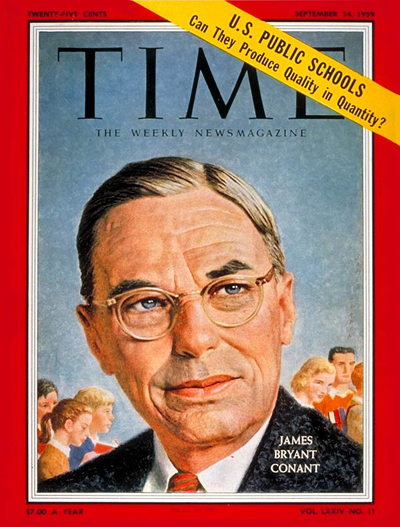
II. Jimmy Conant.  At a practical level, James B. Conant (above) has undoubtedly had a greater organizational affect on education than John Dewey. Conant is perhaps best known for leading the charge for the kind of high school we take for granted today: the comprehensive high school. Reviewing Conant's The American High School Today one contemporary commentator noted the following items of interest:
James B. Conant states as his top priority the elimination fo the small high school, thus joining the legion of modern educators who have fought stoutly for consolidation.
The Report assumes , without questioning that proliferation of many subjects is better than concentration upon fewer, that four of something is necessarily better than two or three, that twenty or more courses during the high school years are better than sixteen, that a seven or eight period day is better than one with a block of time for a core...
The report repeatedly deals with the shadow, not the substance, of the curriculum. ... Almost completely neglected is the crux of the curriculum problem: what goes on within the courses.  
At that last sentence one might heave a sigh of relief: Oh, but we have content standards now - problem solved!. However, the dirty little secret (which Common Core will change not much at all either way) is that standards are merely one link in the chain of communicating content. Whether the weakest link is the teacher, the student or the textbook is perhaps a fruitless argument for another day.

Yet even if content standards did miraculously appear each and every course, the core problem would remain: after four years of high school, how will the average graduate answer the question, What are people for? The approved pedagogical gods at the State level don't bother asking the question so we can only get at their answer(s) by indirection. I'll try to get there by way of Mortimer Adler, so a few words about him first.

 III. Mortimer Adler. If Dewey was concerned with educating for citizenship and "real life," Mortimer Adler's concern was more ambitious but more achievable: give everyone the best possible education. With his emphasis on Big Ideas, Great Ideas, and Great Books, the rotten tomato labelled "elitist" was oft lobbed in his direction. His pithy reply was, "If everyone get this kind of education, it's no longer elitist, is it?" or words to that effect. Adler often credited and quoted Robert Hutchins: The best education for the best is the best education for all. 

If I were to put the question What are people for? to Mortimer Adler, what do I suppose his response might be? I suspect he would reply to be educated. Were I to press him and I'm sure he would humor me, he might very well reply: To be educated means to have an education in the humanities. As I wrote in 1983: "Humanities, as general learning, must include all the subject matters, not just some" (quoted in "Reconstituting the Schools").

All the Subject Matters?

I. An Outline of Knowledge.  In A Guidebook to Learning Adler summarizes what he takes to be an outline of knowledge:

  1. Matter and Energy
  2. Earth
  3. Life on Earth
  4. Human Life
  5. Human Society
  6. Art
  7. Technology
  8. Religion
  9. History of Mankind
  10. The Branches of Knowledge
    1. Logic
    2. Math
    3. Science
    4. History and Humanities
    5. Philosophy

II. California Content Standards.  When this is compared to current California K-12 content standards, we get a very different picture of essential knowledge. Here's a summary of California standards:
English-Language Arts
Mathematics
English Language Development
Career Technical Education (consisting of 15 areas, ranging from Agriculture to Transportation)
Health Education
History-Social Science
School Library Standards (how to research and gather information)
Physical Education
Science
Visual and Performing Arts
World Languages 
Excursus

This excerpt from T.S. Eliot's "Choruses from 'The Rock'" gets at the heart of the matter:

The endless cycle of idea and action,
Endless invention, endless experiment,
Brings knowledge of motion, but not of stillness;
Knowledge of speech, but not of silence;
Knowledge of words, and ignorance of the Word.
All our knowledge brings us nearer to death,
But nearness to death no nearer to God.
Where is the Life we have lost in living?
Where is the wisdom we have lost in knowledge?
Where is the knowledge we have lost in information?

Both Adler's outline and California's standards propose categories of knowledge. There is a wide swath of common ground, but what is missing or superfluous in the California standards according to Adler?

Adler would surely exclude from the category of general learning everything in Career and Technical Education. Missing from the California standards are the following: Religion, Logic and Philosophy.

One can argue for the omission of Religion on all sorts of grounds but the omission cannot be attributed to recent U.S. Supreme Court decisions. The following is a portion of a statement found on the ACLU's website:
Teaching About Religion
5. Students may be taught about religion, but public schools may not teach religion. As the U.S. Supreme Court has repeatedly said, "[i]t might well be said that one's education is not complete without a study of comparative religion, or the history of religion and its relationship to the advancement of civilization." It would be difficult to teach art, music, literature and most social studies without considering religious influences.
The history of religion, comparative religion, the Bible (or other scripture)-as-literature (either as a separate course or within some other existing course), are all permissible public school subjects. It is both permissible and desirable to teach objectively about the role of religion in the history of the United States and other countries. One can teach that the Pilgrims came to this country with a particular religious vision, that Catholics and others have been subject to persecution or that many of those participating in the abolitionist, women's suffrage and civil rights movements had religious motivations.  
Constitutionally permissible but nearly unheard of. Yes, one may find the occasional Bible as Literature or World Religions course but more likely religion is alluded to in a hit or miss fashion in a literature class here or a history course there.

Logic and Philosophy? Much the same.

So, what are people for
according to our public schools?

Wanda the Welder
One can only guess. Pride of place clearly goes to the world of work. But the absence of any emphasis on religion, logic and philosophy clearly indicate an unseriousness (at the state level) of a humanistic, general education. Liberal Arts? Just say No.

Saturday, January 09, 2016

"The Hunt"

The Hunt

Mads Mikkelson (who was just fantastic in the hilarious, profound and scary Adam's Apples) plays a teacher in The Hunt who has taken a job at a kindergarten because the local school closed. He gets into a custody battle with his wife, starts falling in love and gets accused of inappropriate behavior with a child.

Any one who has been falsely accused will quickly identify with the protagonist. Scary, haunting but ultimately redemptive.

If I could create a genre for this film, I would call it epistemological: it asks to consider what we know and how we know it. It touches on several themes but does not conflate to a moral tale about the dangers of witch-hunts and hysteria, nor does it demonize those think Lucas (Mikkelson) guilty of the "crime." A very un-Hollywood kind of film. Friendship, family, love, hate ... it's all in there.

Mature theme with some sexuality (but pretty tame for the Swedes if those vicious stereotypes are true).

Wednesday, December 30, 2015

A Book I'll (probably) Never Teach

Walker Percy's Lancelot 


Clearly Percy's darkest novel and most theologically daring. So, what's not to like? Why not teach it? Well, the immediate objection at the high school level is the sex. But that's just an obvious objection. The deeper problem is with the inability of the average student to even see what Percy is getting at. I got it (finally, after a much closer, second reading) and his point is well worth noticing:

I. Modern man is confronted with three possible modes of existence

1. The "go along, get along" nihilism of the super-majority who may not have the indecency to be lewd but worship lewdness at the altar of the Hollywood Stars. Then there are the hyper-sexualized Stars themselves who turn out to be utterly vacant. Some examples:

I looked at Maude in astonishment. Had everybody in this town gone nuts or was I missing something? The special nuttiness of movie people I was used to, but the town had gone nuts. Town folk, not just Maude, acted as if they lived out their lives in a dim charade, a shadow-play in which they were the shadows, and now all at once to have appear miraculously in their midst these resplendent larger-than-life beings. She, Maude, couldn't get over it: not only had they turned up in her library, burnishing the dim shelves with their golden light; she had for a moment been one of them! (Page 138, Ivy Books edition, 1993)
Dana was something to see: barefoot, tight jeans with silver conch belt, some kind of pullover homespun shirt, necklace with single jade stone, perfect helmet of yellow hair, perfect regular features, perfect straight brows flaring like wings. He moved well and had grace. He was a blank space filled in by somebody's else's idea. He was a good actor (133).
I didn't think Raine was wonderful. She was amazingly pretty, with a pure heart-shaped face and violet-cobalt eyes which seemed to look from her depths to yours, a trick I came to learn, that steady violet gaze, chin resting on the back of her bent hand. Her depths were vacant (100). 
2. The Neo-Stocism/Southern Ideal of Lancelot that is agnostic about God, Christ and love but certain of how to act. How to be in the world that is this corrupt:
I cannot tolerate this age. And I will not. I might have tolerated you and your Catholic Church, and even joined it, if you had remained true to yourself. Now you're part of the age. You've the same fleas as the dogs you've lain down with (144).
Then how shall be live if not with Christian love? One will work and take care of one's own, live and let live, and behave with decent respect towards others. If there cannot be love -- you call that love out there? -- there will be a tight-lipped courtesy between men. And chivalry toward women. Women must be saved from the whoredom they've chosen. Women will once again be strong and modest. Children will be merry because they will know what they are to do (145).
Which is worse, to die with T.J. Jackson at Chancellorsville or live with Johnny Carson in Burbank? (144)

 3. Christianity. 
If you were right, I could stand it. If your Christ were king and all that stuff you believe -- Christ, do you still believe it? -- were true, I could stand it.... I could live your way if it were true (140-141).
II. Lancelot's Quest is Fulfilled in Percival

As is Percy's way, the novel ends on an ambiguous note (what will Lancelot in the end do with his life?), but what is clear (after my second reading; after my first, I was merely flummoxed) is that Father "Percival," the nearly voice-less listener to Lancelot's tale or confession, is converted by Lancelot's quest for evil, for sin. Lancelot alludes to Percival's lack of faith throughout the novel:

  • There is only one way and we could have had it if you Catholics hadn't blown it: the old Catholic way. I Lancelot and you Percival, the only two to see the Grail if you recall. Did you find the Grail? You don't look like it (162).
  • You don't even  believe it yourself, do you? ... But if what you once believed were true, I could stand the way things are (140). 

Percival, the priest-psychologist has lost his faith. Lancelot sets out to definitively prove the existence of evil/sin and thereby force the world to make sense, but in the end Lancelot cannot see it. Percival does. Some relevant passages:

  • The truth is that during all the terrible events that night at Belle Isle, I felt nothing at all. Nothing good, nothing bad, not even a sense of discovery. I feel nothing now except a certain coldness. I feel so cold, Percival. Tell me the truth. Is everyone cold now or is it only I? (236)
  • Come here [Percival] and stand with me at the window. I want to show you something, some insignificant things that you may not have noticed. Why so wary? You act as if I were Satan showing you the kingdoms of the world from the pinnacle of the temple (237).
  • I'm like that old lady at the window across the street. I don't miss much. For example, I saw you earlier down there. In the cemetery. Surprised? I saw what you did, even though you did it very quickly. You stopped at a tomb and said a prayer. [Earlier in the novel Percival refuses to pray for the dead.] A relative? A friend? A request? So you pray for the dead. You know, something has changed in you. I have the feeling that while I was talking and changing, you were listening and changing (238).
Beautiful, subtle, unexpected. But not one I'll probably ever teach. Bummer. 

Saturday, November 14, 2015

Books of the Month: October & November

As I prepare to retake the California Subject Examination for Teachers (English, Subtest IV), I'm reading and/or re-reading some "classic" or at least perfunctory high school texts. For the sake of being better prepared for the four short response (but high stakes!) questions, and just for the fun of it.

October 2015: To Kill a Mockingbird. The first part seems to really drag. Perhaps the way I was reading it or perhaps Harper Lee was getting paid by the word? In either case, it was interesting and generous toward our human complexity. I like the wee lil girl perspective that comes through Scout and her growing awareness of the world as a place far more dangerous and interesting than at first suspects. Yeah, the injustice totally sucks, but we saw that coming. A moral perspective infuses the book: What if you simply can't change the system (for we are all implicated in those systems) and you just have to endure the evil and strive after the good -- what then? Where and how will you stand?

November 2015: William Shakespeare, "Romeo and Juliet." Love Hard, Die Young. What's not to like? Most interesting for me is the sense of redemptive-tragedy. Yeah, the kids die and several of their kin but we don't have the Chorus showing up and saying, "Hey, this is what happens when you mess with the gods." Instead we have the reconciliation (not annihilation!) of the warring clans and the Prince concluding (ironically?): 
A glooming peace this morning with it brings.
The sun for sorrow will not show his head.
Go hence to have more talk of these sad things.
Some shall be pardoned, and some punished,
For never was a story of more woe
Than this of Juliet and her Romeo.
Would that all strife end in peace.

Saturday, October 31, 2015

Questionable Music: an Alternative to Despair

What happens when students have had three weeks of random substitute teachers?

A flippant response would be, "Nothing good!" That is close to the money, but I had a chance to sub this week for a week's worth of lessons. It's an unfortunate situation when a teacher has an unforeseen situation and it doesn't quite merit a long-term sub. The teacher suffers, the subs suffer, and the students become disoriented and -- some -- become derisive and cynical.

After the second day with these students, it was clear that something beyond worksheets was required. (We had just finished the French Revolution and it seemed to me to be a distinct possibility that if I handed them another worksheet, I might be ascending the steps to the Guillotine!)

The curriculum called for moving into the Industrial Revolution and remember subbing a few weeks before for a psychology teacher in Roseville. I played the video. The video was about memory and how the mind remembers best when there is a context. In the video, one of the shrinks spouted off a set of random numbers and asked us, his audience, to remember them: 1-7-7-6-1-8-1-2-1-8-6-1-1-9-1-4-1-9-4-1, Impossible. But then he said, "American history." Ah, yes, key dates in America history. Easy to remember.

Remembering this, I thought, "How do I give a simple but memorable introduction to the Industrial Revolution?"  I found a catchy (or perhaps irritating if you have taste in music) music video on YouTube and two other songs (one on consumerism, the other on oppressive work).

It was more interesting for me than another worksheet. Based on our discussions in class, same for some of the students.

Industrial Revolution Musical Retrospective


Sunday, October 18, 2015

DEATH SENTENCE - Almost as good as Sharknado!

Good Heavens!  Rating: 3 out of 5 amputations below the knee

Still of Kevin Bacon in Death Sentence (2007)
Where does one even begin? This is perhaps the funniest movie I've seen since Sharknado!  Granted, with the shark film, I had already braced myself for absurdity but with Death Sentence, I had no idea what kind of film I was getting myself into.

The premise is intriguing: a father witnesses his son getting killed in a random act of gang violence, and decides to take the law into his own hands. This could go in multiple directions, all of them interesting. Moral complexity? Well, the raw material is there but you won't find it here.

What you will find is Kevin Bacon as a kind of Clark Kent miraculously transformed into The Terminator. Professionally, he works for a corporation and seems to be responsible for -- risk management! The film is politely incoherent and all the bad guys get wiped-out (this was not a surprise once I realized the film was not serious).

Special effects are from the George Romero School of Film: a dead cop in the car who has a fountain of blood streaming from his neck; one gang member flies in the air 30' when a car hits him and he's doing just fine in the next scene; another gang guy loses the lower 2/3 of his leg below the knee after a blast from Bacon's 12 gauge shotgun in a moment that is reminiscent of the knight fighting scene from Monty Python's Holy Grail. Rich stuff.

The award for best contrived scene surely goes to the rooftop garage scene where Bacon wraps a seat-belt around a bad guy's neck and the car -- defying gravity as it propels itself up a slope! -- flies off the 3rd level and onto the ground. Sheesh, sometimes seat-belts don't save lives! 

There's also a great chase around the house almost as funny as Inspector Clouseau versus Cato in The Pink Panther Strikes Again. The highlight is when Bacon literally pulls the rug from under a bad guy right before he blasts him.

Best unfathomable moment is after Bacon has shot up the town and returns with his rat-scalped self to his now empty house (he has succeeding in getting his wife killed). The lady detective shows up with a convoy of cop cars to his house to ... tell him his remaining son is going to be okay! No arrest, no lecture about going on a killing spree, just good news. Holy Implausibility, Batman! 


Not to be missed: the scene where Bacon shaves his head badly and at the same time plays with various guns and ammo. It lasts about ten minutes but the haircut is worth every second.

Look, I know Kevin Bacon, John Goodman, and, yes, Renee Russo all need to make a living, but is this sort of thing really necessary.

Wednesday, May 22, 2013

Glenn Beck, Nihilist

If you're like me, when you hear "nihilist" you think of someone like Friedrich Nietzsche (as a dapper young man, below), not a radio personality such as Glenn Beck.

http://upload.wikimedia.org/wikipedia/commons/thumb/b/be/1864c.jpg/175px-1864c.jpgBut today I thought of Mr. Beck as deeply nihilistic when I listened to his radio show. I confess to a certain fascination in listening to his show. He puts me in a bit of trance actually, and on some commutes, that's nice.

What's not nice is nihilism.  Without being overly pedantic, nihilism is the philosophical (and religious) conclusion that everything is, in the final analysis, meaningless. Meaningless because there is no substance to reality; only transitory impressions and bodies that carry them, and then they all fade to black.

Atheism isn't really the main point (though it certainly implies atheism and an atheist would need to struggle mightyly not to view reality nihilistically.

Perhaps a film clip would help. Lacking that, there is a bit of brilliant dialogue: In Signs, Mel Gibson's Father Hess (how's that for a pair of opposites!) has concluded that "There is no one watching out for us; we are all on our own."

Life, death, love, beauty, justice, goodness and desire all absurd and destined to die with our deaths. Cheers!

Mr. Beck's Nihilism.

Now I don't know exactly Glenn Beck's religion or particular denominational flavor, but functional nihilism is certainly compatible with a belief in God. Functional nihilism is similar to Pelagianism in the moral life: Jesus is an example for us, but we must struggle mightily (and alone!) to perfect ourselves. Beck seems to takes this view and transpose it to the social and political order.

The nothingness in Mr. Beck's world is indicated by the word "we."
  • We must do this.
  • We must join him now to do that.
  • If we don't do something now, what-have-you will happen.
I get exhausted just listening to him. I'm gratified that Mr. Beck's perspective is not, "It's all about me," but all this talk about we and us is a little ridiculous. Our President habitually slips into the egotistical "I" more often than commentators can count, but the less-than-royal We of Mr. Beck contains the same kind of presumption and encourages a kind of group think that is very unattractive.

Being, not being busy.

Albert Borgmann in Holding on to Reality notes that hyperactivity and sullenness go hand-in-hand. Just watch a teenager after playing 12 hours of Halo or somesuch. Busyness is not just for teens and the emptiness that drives busyness is pandemic in our culture today.

At the heart of emptiness lies nihilism: the conclusion that the alternatives are perpetual stimulation or despair from the yawing abyss inside.  The wonder of nihilism is that one can be infected and not even realize it.

Fortunately or not, the truth is that we (there I go!) can't save ourselves, and we can't give ourselves life. Sorry, Mr. Beck, something deeper is at the heart of reality. When we pay attention to that we become fruitful.

Thursday, May 09, 2013

Blue Like Jazz

https://blogger.googleusercontent.com/img/b/R29vZ2xl/AVvXsEi4cXy0d41HEAya888g2ci-PVTzVdu2hd5Fv_9DqfLdGEIvnkF0ofBjXl_NqGeYjVTYsUqmxJKabjDdv6KEntSl0iudXtIpqByXDKd1vc9iGbA4qvrtlESsrpG6l-Qwi8hKy6ZK3g/s1600/leftbehind1.jpgIf you're like me, every time you hear "Christian movie," you reach for a jug of Pepto-Bismol (and maybe some holy water, for good measure). 

With rare exception, most are deplorable. Christ is not glorified, but dare I say, horrified.

If you get the DVD of Blue Like Jazz, you may want to fast forward through the trailers. They are "Exhibit 'A'" of horrendous "Christian" movies.

Thus my expectations were very low when watched Blue Like Jazz, but I was pleasantly surprised. It did what the stereotypical Christian movie can't quite get itself to ever do: stay close to human experience. 
You know what I mean: the Christian film that begins with a premise of what life ought to be "from a biblical perspective" (does the Bible have eyes?) and then simply transposes this ideology into the realm of dialogue and wooden acting.

Granted, having good intentions and thinking this is enough to make a good film is not the folly of just Christians (but it seems to "help"): Freedom Writers nearly drove me to violence with its sweetness-unto-death.
Blue Like Jazz does something that is rarely recognized in film (or anywhere else in popular culture). It acknowledges the failure of Christians but insists upon the power of Christ. Now that sounds all pious, doesn't it? But what I mean is that it puts on display evangelical (well, Southern Baptist) absurdities, but in so doing it does not dismiss the religious questions at the heart of religion (the questions of Southern Baptists, too!). 
The film suggests that scandal does not dispense one from seeking out the meaning of life.
Donny's struggle is any thinking person's struggle: how do I reconcile the disproportion between who Christ is and the radical deficiencies of Christians? The film seems to answer it by saying, You don't. That is, the mystery of sin and evil are not problems to be solved, but are mysteries at the depths of each of our hearts.
Living as if God doesn't exist, doesn't solve the problem of sin and evil. As the saying goes, "Where ever you go, there you are."

The film touches upon the themes of scandal, friendship, higher education and meaning. A perfect film? No. But certainly one that can be enjoyed and re-watched. No Pepto-Bismol required.

http://www.reed.edu/reed_magazine/sallyportal/assets/images/BLJ_pope_library.jpg


Wednesday, April 10, 2013

Political Pitfalls

I've recently becoming engaged in writing my senators and congresspeople (state and federal) over proposed new laws concerning firearms. I'm a bit scandalized that it was this issue that awoke me from my political slumbers, but perhaps we can't choose what will serve as a spark to get us moving. In the process of listening to right and left debate the issue, and watching myself become involved, it has become clear that both sides not only reduce the issue to opposing soundbites, but also reduce the humanity of the opposition.

Here in Colorado, one agitated pro-gun guy left a nasty voice-mail for a female African American representative in which he hoped for her violent demise; on a national lefty talk show, Randi Rhodes opined that gun manufacturers don't care how many innocent people die by the abuse of their product as long as they make a profit.

Emotions are a wonderful thing. They can draw us closer to reality (think of how love allows one to better see the beloved). They can also have the opposite effect: they can occlude reality and make us disconnected from others.

Party of God?

When it came to political activism, Jesus never met people's expectations. In Jesus' day as in our own, there were plenty of “leaders” who had all the answers but misconstrued the questions. In St. Mark's gospel we read of this example:

And they sent to him some of the Pharisees and of the Herodians; that they should catch him in his words. Who coming, say to him: Master, we know that thou art a true speaker, and carest not for any man; for thou regardest not the person of men, but teachest the way of God in truth. Is it lawful to give tribute to Caesar; or shall we not give it? Who knowing their wiliness, saith to them: Why tempt you me? bring me a penny that I may see it. And they brought it him. And he saith to them: Whose is this image and inscription? They say to him, Caesar' s. And Jesus answering, said to them: Render therefore to Caesar the things that are Caesar' s, and to God the things that are God' s. And they marvelled at him.

Jesus doesn't give them an answer and yet He does give them the opportunity to face the question in the right way.

In America today, there is no lack of answers, but there is an abysmal absence of thoughtful questions. Democrats and Republicans count of the people's ignorance and sloth to win votes and the media gleefully repackages these political reductions of reality.

From gun-control to education to “sexual health,” seemingly everyone is willing to demonize the opposition and reduce debate to a shouting match. In such an environment, one could retreat to a cozy apolitical ghetto. Or one could decide to be a protagonist.

The recovery of the human

Antagonists and antagonisms are never lacking. The question is not really What would Jesus do? but How do I face the whole of reality? (and this includes the political). This is a personal work that cannot be placed on the shoulders of others – no matter how correct we view their positions. Catholics in America need fewer gurus, not more. Ours is an age of alleged experts and this applies to the ecclesial and secular environments. This does not mean that others cannot be witnesses or guides for us; it simply means we need to take seriously the personal responsibility that being Christian is.

Perhaps what Catholics can bring into the public square is not necessarily better answers, but to see and bear witness to the questions that lie at the heart of our political dis-ease. Of the need for this, one can simply think of how one views the opposition (of whatever sort): are they even human?

Getting back to my vexation over the gun-control issue above, I can assure you that I've had moments of doubt about the humanity of political opponents. In short, it's been quite easy to shift from seeing them as folks made in the image and likeness of God to viewing them as hostile matriarchs and metrosexuals trying to “take ma guns away from me.” But this way of thinking is useless.

For real political progress to occur in America, there needs to be acknowledgment of our human needs and our solidarity with others, regardless of party or politics.

Fr. Julián Carrón recently noted that in Europe politicians are “more defined by party alignments than by self-awareness of their ecclesial experience and the desire for the common good” (La Repubblica, 10 April 2013). Our recent national election bears out that this is true not only for politicians, but for the electorate as well.

We don't need more political parties, but we do need to attend to what is most human in ourselves and in others.


Friday, March 08, 2013

Thoughts on gun control (1 of ?)

How not to understand gun violence

In Whit Stillman's Barcelona one finds not only an anti-communism, the failures of promiscuity, and the virtues of friendship, but it also offers this reflection:

Spaniard: You can't say Americans are not more violent than other people?
American: No!
Spaniard: All those people killed in shootings in America?
American: Shootings. That doesn't mean Americans are more violent than other people. We're just better shots.

Here in Colorado, Democratic lawmakers would seem to competing with Mr. Stillman's comedy while lacking his insight and sense of irony. There is something profoundly true in what the American in the quotation above doesn't quite get around to saying: the correlation between violence and guns is something mysterious. It is surely not the case that firearms training (e.g., marksmanship) increases gun violence, but it is also not the case that we understand the connection between guns and violence. Violence comes from our sinful nature and anyone who thinks he understands that is a fool or a saint.

The four pieces of legislation proposed in the Colorado House do nothing to reduce the criminal and/or violent use of firearms but they give the appearance of concerned legislators “doing something.” In this they are serving as stereotypical examples of government bureaucrats who look busy but accomplish nothing.

Colorado's freaky foursome

Here's a quick summary of each of the four bills (they may be law by the time you read this).

House Bills 1228 and 1229 do two things: (1) mandate so-called universal background checks and (2) charge the checkee a fee for being investigated. At one level, part of this makes sense, on another, its frivolous and insulting. It is already illegal to knowingly transfer a firearm to a felon or other person barred from ownership/possession of a firearm. I have moral certainty about a host of friends, to whom I could transfer a firearm; they are neither felons nor loons. Why this bureaucratic mandate to verify what I already know (to wit: Uncle Larry is not a felon nor a barking lunatic?).

There are good intentions here, but I think appealing to people's sense of civic duty via public service announcements would be more effective. Ads that had some slogan such as "When in doubt, don't sell." Or how about a non-punitive way of encouraging background checks, such as a fee-less background check and a Starbucks gift card. Can't we be a little creative here? Those crackheads (the non-Starbucks variety, that is) who are trading guns for drugs are breaking existing law.

And the fee? A silly hoop meant to discourage a perfectly legal activity.

HB 1224 limits magazine capacity to 15 rounds (cartridges). Look, I realize Hollywood does a very poor job of portraying the reality of firearms and their limitations (for example, Rambo and his infinite supply of ammunition), but this is just silly. All kinds of magazines in the 20, 30, 40 and 75 round capacities are in circulation. Suppose you did get them all off the street? Mr. Badguy will simply buy multiple magazines. Depending upon the firearm, a magazine change can be effected in 2-3 seconds or less. Criminals may be crazy but they are neither stupid nor uncreative - they'll find a way to kill, period. This bill was crafted by someone who knows nothing about firearms or their use.

HB 1226 designates state college campuses as concealed carry-free zones. Perhaps a better term would be “free-fire zones.” Did Jimmy “Bad Hair” Holmes see those firearm-free signs in Aurora and say, "Oh, my bad, I'll go somewhere else to commit an atrocity" or did he see those signs as encouragement to slaughter innocents? Common sense tells us the answer. All this sort of thing does is tell wackos where they are less likely to face resistance, and hence it encourages them to ply their twisted trade there.

The subtext of these carry-free zones is, “You're in college, you're semi-moronical (probably a frat boy to boot), and we can't expect you to exercise intelligence or restraint.” Wow, and the future in America is in their hands.

I'm the NRA and I choke
We have very solid laws (state and federal) on the books concerning firearms and their misuse. The NRA is always beating this drum, but it is also true: if more time and energy and, yes, money, were spent on enforcing our current (reasonable!) laws, gun-related criminal violence would likely decrease.

I don't care for much of the NRA's “Chicken Little” rhetoric. I detest violence, and yet I joined the NRA for the same reason I've voted for some creepy Republicans in the past: to put a check on people and policies that are worse.

All of this may seem like another diatribe from a single issue guy. Let me open the issue up to what ought to be of concern to all Catholics and everyone of good will: the relationship of gun control and race, and the difference between violence and legitimate defense in our Catholic tradition.

Arms and race

In The Atlantic Adam Winkler credits the Black Panthers with launching the modern gun rights movement. Seriously. Much to the chagrin of then-governor Ronald Reagan, in 1967 the Panthers came to Sacramento armed to the teeth and marched into the state capitol demanding that their right to bear arms be respected (see “The Secret History of Guns,” September 2011). Naturally, they were arrested. What's beautiful about this piece of historical trivia is that it makes everyone a bit uncomfortable. White guys like me are scared to death of fierce African Americans running around like some redneck Idaho militiamen. But it is the gun-control advocates with the leftward sympathies who get the real cognitive dissonance: they're black, they're hip, but they got guns!

The Panthers in a sense were paying whitey back for what had happened in the South after the Civil War. Gun control laws were passed after the war and applied equally to blacks and whites! Well, on paper. Good ol' Jim Crow ensured that blacks were disarmed and whites kept their guns. Imagine the inconvenience to the Kluxers if blacks were armed. Why they would have an unfair advantage over the men in pointy hats. How could the Klan have possibly lynched, raped, murdered and intimated the freedmen if they were armed? No, “gun violence” had to be minimized, and gun violence meant a gun in a black man's hand.

Race is certainly not the only factor is gun control, especially today. But it is a part of the puzzle (just as racism helps explain the wickedness of Maggie Sanger and her present day “offspring”). Black and white, we all are made in God's image and have inviolable dignity.

Equal protection

Cardinal Dolan recently blogged about his support for new gun control legislation. When it comes to Catholic doctrine, I suspect the cardinal and I are in full agreement; when it comes to the implications of that doctrine, well, that's a different matter.

Three quotations from the Catechism of the Catholic Church and the Compendium of the Social Doctrine of the Church are particularly relevant:

Legitimate defense can be not only a right but a grave duty for one who is responsible for the lives of others (CCC 2265).

Violence is never a proper response. With the conviction of her faith in Christ and with the awareness of her mission, the Church proclaims “that violence is evil, that violence is unacceptable as a solution to problems, that violence is unworthy of man. Violence is a lie, for it goes against the truth of our faith, the truth of our humanity. Violence destroys what it claims to defend: the dignity, the life, the freedom of human beings (CSDC 496).

The right to use force for purposes of legitimate defence is associated with the duty to protect and help innocent victims who are not able to defend themselves from acts of aggression (CSDC 504).

Notice the distinction between violence and legitimate defense. I have a right to protect myself and others. “Grave duty” suggests there are times when I would be sinning in not protecting someone else, and this comports with basic human decency. Yet I have no right to act violently or aggressively. What seems to be the same act at the level of appearances (e.g., discharging a firearm) could be the fulfillment of a duty or an atrocity. It just depends.

Furthermore, this is not England. What is proportionate in stopping violent acts there (cricket bats? a discourse on gentlemanly behavior?), does not apply here. We are awash in a veritable sea of guns. Is it prudent to ask civilians to unilaterally disarm? Criminals won't. What we can expect from unilateral disarmament on the installment plan is a lot of Lenin's cracked eggs to make an omelet: disarmed civilians slaughtered in the name of non-violence and peace. This is no benign paradox but a horror.

The next installment will discuss some aspects of the “world view” of gun-owners and how this helps explain our shrillness.


Sunday, January 13, 2013

The Silence of the Lamms

Dick and Dottie Lamm are ex-Governor and ex-First Lady of Colorado. The latter Lamm wrote a confused diatribe in the Denver Post.  My diatribe below is a response to Ms. Lamm.

I am aghast at Dottie Lamm's crude sexism: she is against forced female feticide but gleefully agrees that there is an excess of Indian males.

Perhaps I'm just old-fashioned, but it seems that once one begins saying there are “too many” of whomever, one has begun marching to a Hitlerian drum. These 15 million males didn't ask to be born anymore than the 15 million dead girls asked to be aborted. The girls are dead but the boys are told they are worthless: the ones who got away but have no purpose or place; they are mere parasites on the body politic.

It is ironic in the extreme that Ms. Lamm's husband was instrumental in bringing abortion to Colorado in 1967. His motto might have been “kill 'em all, let God sort 'em out,” but Ms. Lamm's approach seems to thrive under the rubric of “affirmative action destroyer”: let's not kill more girls than boys. She's placid about mayhem and murder except when it begins discriminating against women.

Here's the problem in putting lethal force in private hands and authorizing its use against innocents: there's no way of controlling the violence. As Pandora learned, you can't put a lid on some things once you've freed them.

But why swim against the current? Perhaps what is needed is more violence. Maybe the dynamic duo of Dick and Dottie could put their ideology into action and go on a diplomatic mission to India. Their traveling companion would be a small atomic device. Arriving in New Delhi they could set that baby off and retroactively abort 20 million or so New Delhians. What's good for the goose is good for the gander. Yes, there will be some collateral damage among the womenfolk, but surely the ideal of equality is worth the price.

Better yet, we can simply repent of our violence and stop killing each other inside and outside the womb. The “Silence of the Lamms” to the contrary notwithstanding, we are all made in God's image and likeness, male and female. There is no excess of males, only a pathetic deficit of love.

Saturday, February 18, 2012

A Meaningful Education

This was published in the web edition of the Denver Post on 11/27/11 (here the link)

Link

I was recently at our local public library and overheard two high school girls discussing teen pregnancy. Why, they wondered, would a girl do that? I had to bite my lip to not offer my opinion: "They get pregnant because it's more interesting than school."

Motherhood — even teen motherhood — is both an adventure and an opportunity filled with possibility. It promises a new life, the deepest affection thinkable (that of mother and child), and, yes, possibly great peril. Through pregnancy, the teenager enters into a dramatic story.

The story public schools tell girls (and boys) is decidedly less interesting. It is the story of so-called success through studying hard and getting a good job. For those students who — because of habit or incuriousity — are content to study bits of knowledge disconnected from each other, public education "works": they study hard, get good grades, get accepted to college, finish college and (perhaps) get a decent job.

For many other students, this vague success narrative is neither appealing nor credible. It is no wonder that so many are drawn to drugs, alcohol, bad music, video games, and promiscuity. Beyond the anesthesia, these things provide a guide for life which is more compelling than the tale of economic utility and suburban respectability. Since the schools won't provide an interesting or compelling hypothesis of meaning, the kids find one ready-made or invent one.

Some will argue that the role of public schools is not to dabble in questions of meaning or anthropology or, heaven forbid, metaphysics, but it is obvious to any clear eyed observer that they have been doing this for some time. The meaning of life as envisioned by the public school system has already been summarized: you exist to be a productive member of society; whatever else you do is up to you.

The tacit anthropology is that the student is a weird hybrid of snowflake and machine: utterly unique but capable and urged to emit correct responses that the teacher-technician has inputted. Metaphysically-speaking the schools flail about in a case of terminal agnosticism: God may or may not exist, but in a clever reversal of Pascal's Wager, it is best to bet everything on the chance that He does not.

For more than ten years I taught in public schools: one prison and three high schools (in four different cities). One might think I saw a great deal of diversity (I did), but the underlying assumptions of these four institutions was fundamentally the same. Two major assumptions are that the person needs a lot of information but very little else, and that education can be separated from the question of what makes for a good life.

In the midst of my present "sabbatical," I've had the opportunity to teach some homeschooled Catholic high schoolers and the contrast with them and their public school contemporaries is amazing. They are bright, curious and open; they are not sullen and bored. The homeschooling parents aren't rich but they have communicated a rich hypothesis of meaning to the kids and the kids have an opportunity to verify something concrete and definite about life.

Such possibilities ought not to remain the privilege of the rich or those willing to make huge familial sacrifices. It is imbedded in our nature to seek the meaning of our lives.

Some find that meaning in religion while others find it in irreligion. Some find it in the "bad infinity" of pursuing wealth and shopaholicism.

Still others find the present public secular education perfectly acceptable because existential questions are of no interest to them. The point is this: if we take the idea of American pluralism seriously, this pluralism ought to extend into K-12 education. If the State cannot do this (for whatever reason), perhaps the State needs to get out of education.

Or, if not out entirely, then it may be necessary to radically reconfigure how the government funds education so that the idea that parents (not the State) are the first and irreplaceable educators of their children is properly supported. This isn't rocket science; it's simple democracy.

Matt McGuiness is a freelance instructor. He can be reached at mjmcguiness@gmail.com.

Friday, February 17, 2012

Sometimes soundbites speak volumes...

I caught this on the radio (AM 710, KNUS), but I'll have to paraphrase it because I didn't write it down (nor could I find it on the station's website).
In an interview about a sexually explicit texting case at an area school, the principal said in response to a suggestion that students be barred from bringing cell phones to school, "We can't do that, cell phones are so much of their culture."
Ah, yes. The schools don't have a culture of their own to propose; rather, they are in perpetual retreat against the forces of barbarism. Yet another example of how schools simply react instead of acting.

A simple question: What is the purpose of education? If it is just to keep kids busy, well, then yes, the principal is correct: short of killing each other, let them do what they want. If, on the other hand, school is a place where cultural presuppositions can be challenged, then perhaps the cell phones can and should go. Placate or educate? The choice is ours.