1973 - when I started asking questions, like, "Why are we all dressed so funny?"
Showing posts with label Socrates. Show all posts

Thursday, December 10, 2015

Furniture. Or "Saint Ikea, Pray for Us!"


American society at times seems to hinge upon the thesis that buying stuff is "transformative" and necessary for self-realization, so I hate to aid and abet that point of view. However. However, there is something to be said about classroom space.

By space I mean the physical dimensions of the classroom and the arrangement of furniture and its types. Take the typical seat-desk combo found in many schools:
Exhibit A
Sleek, sturdy but of single purpose. Note the fusion of table top and chair (the wire basket underneath is well-intentioned but becomes merely a place that good lose things or place their trash). With this unity of table and chair, there can be no separation. The unit is heavy, unstackable and expansive.

Here is a better alternative: 
Exhibit B
I have come across only one classroom that uses these but they are in service! Notice the adjustable height for starters. Then check out the space saving design (nothing extends beyond the length of the "feet"). Granted, the military hospital green is little dull, but that is far out-weighed by its practicality:

  • Need space in the center of the room? Stack 'em! 
  • Need a way to section off space in the classroom? Arrange 'em! 
  • Need traditional "rows and columns" for a test? Just do it! 
Why is this important? 

Limitations are manifold in teaching. A simple thing like getting students into the right space for learning ought not to be an obstacle. Exhibit A is filled with peril. Exhibit B allows for creativity and flexibility. 

A dude like John Dewey did not have the limitation of reality when he theorized and laboratorized about education. He could tailor make students and their numbers to suit his purposes. He could cherry pick the raw material and be an artist without the constraints we proletarian teachers face. Alas, I need every edge I can get with a classroom of 40 kids. 

Shared Inquiry Discussion

SID is possible with even 40 students and here's how: Rotate 3 groups of students this way: (1) Inner Circle, (2) Outer Circle, Style feedback, (3) Outer Circle, Content feedback.

It needs some fleshing out but problem is solved in the numbers department. 

I have looked closely at every classroom I've subbed in and asked myself, "Could I run a Socratic seminar in here?" For the vast majority of classrooms the answer has been "Not without a big change in the physical layout!"  Next slide:
Image result for classroom high school packed
Exhibit C
Notice this poor teacher. Not only is he shackled with a man-leash but he must feel a bit claustrophobic. There is no space to move. Nowhere to move the furniture, either. 

"Fulcrum, meet Lever. Lever, Fulcrum."  Enough said. The future belongs to the slim and trim table labeled Exhibit B.


Wednesday, April 17, 2013

Finding Emo OR "Have you no sense of deceny, sir?"


This is perhaps the kind of thing one might expect on The Phil Donahue Show (my generation) or Oprah Winfrey or what have you. To see our President use his office as a platform for such emotional pandering is sickening.

Here's the segment.

I don't blame Mrs. Wheeler or her husband. If such evil befell me and mine, I'm sure I want to do whatever I thought might be constructive. Nevertheless.

The basis for political discourse is not "emotionality" (see Sergeant Lincoln Osirus/Kirk Lazarus/Robert Downey, Jr.) but a reasoned conversation. This is precisely the kind of excess of the passions that Socrates feared. In his trial (see "The Apology" by Plato) he refused to bring in his family as part of his defense. He said that to do so would be to distort Justice. He wouldn't pander.

Obviously, not even the "Narcissist-in-Chief" equates himself with Socrates, but he could get a clue from him. If emotionality is what you got, you ain't got much.

It would be constructive to use research, statistics and data in the gun control debate, but we'll see continue to see overblown rhetoric on both sides.

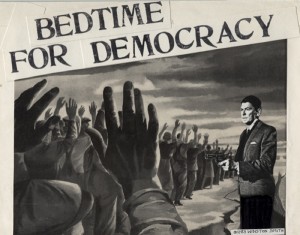
Bedtime for Democracy.

P.S. 

http://media.boingboing.net/wp-content/uploads/2012/10/Bedtime..DemocracyReag.50-300x235.jpg

Love him or hate him, gotta LOVE Jello's wry sense of humor

Saturday, May 02, 2009

Plato I

A Return to Sanity
Pretty bad when reading about a guy who is on trial for his life over trumped up charges seems like "sanity." In comparison to Dewey, Socrates is a breath of fresh air (whereas Dewey is largely stale error). There are so many things to learn about through the "Apology." Something that struck me on this rereading was Socrates' patience in explaining the context of how accusations arose against him. How preconception and prejudice led to his indictment; how he did indeed do things that were, in today's parlance, politically incorrect.
Two for One
As I mentioned previously, taking up an ancient text was motivated by a desire to get some distance from the modern mentality (well represented by John Dewey). Reading the "Apology"
and Aristophanes' "The Clouds" (a first) was also motivated by the opportunity to teach an undergraduate Philosophy course. I was able to get what I think is a very good translation by C.D.C. Reeve - it's certainly more readable than the Jowett translation (see The Trials of Socrates at http://www.hackettpublishing.com).