1973 - when I started asking questions, like, "Why are we all dressed so funny?"
Showing posts with label education reform. Show all posts

Sunday, August 28, 2016

I'm a Simpleton. Are You a Simpleton?

Image result for simpleton

In Walter Miller's tale, A Canticle for Leibowitz, there is a "great simplification" unleashed after a nuclear holocaust akin to Pol Pot's attack on the learned in Cambodia but world-wide in scope.

As I set sail for the year 1493 (that would be Chapter 2 in Loewen's Lies My Teacher Told Me), I feared I was headed for one of Miller's (in)famous Simple Towns where learning has stopped and simple explanations reign. In this I was disappointed that this was the case, but not surprised.

What was surprising was reading Loewen's unconscious mimicking of a the worst approaches to any subject: simplification to the point of distortion. One would think that Loewen would be astute enough to remove the lumber from his own self before railing against the textbooks but it was not to be.

The big question for people like Loewen who congratulate themselves for happening to have been born after the unenlightened hoardes who proceeded them is along these lines: So, are you suggesting that it would be better that you did not exist? According to your narrative, the world would have been better off if Columbus never set sail and history did not unfold as it did. Had it not, I dare say that none of us would be here opining about the crimes of others that we distance ourselves from.

Loewen would prefer a world where the weak are not trampled on by the strong and that is understandable, but that world does not exist. That does not mean sugar-coating the sins of our fathers, but it does mean recognizing that every group of people have done evil. Do you think the Aztecs would have shied away from slaughtering the Spaniards if they had the means to do so? Does a group of people achieve sinless status simply because they get exploited?

C'mon, virtue does follow simple because one has been victimized. Yes, high school history textbooks over-simplify and are vapid, but great books are not created by simply inverting the historical narrative.

Thursday, February 11, 2016

Bad Book, Good Effects


Even a bad book can be useful. Sometimes I read a book and think, "I wish I had written that" or "This author was spot-on." Other books elicit a negative reaction such as "What a waste of paper and ink" or "There goes several nights of reading I'll never get back."

Then there is a third category: books that provoke thought but the book itself is neither admirable nor even readable. Such it is with James Loewen's Lies My Teacher Told Me. The unreadability stems from Loewen's approach which is to mock how one-sided and superficial history textbooks are then wade in with his own one-sided, mean-spirited, and [sigh], superficial approach to the same topic. So, while he does a good show illustrating the failings of hagiography-as-history, he falls prey to demonizing historical figures with a sense of moral superiority complex that self-assuredly suggests, "We know better, are better and will be better in the future... As long as you, Dear Reader, understand that by 'we' I mean 'me.'"  There is no moral drama in Columbus or the Spanairds. They are bad, but then so was everyone else back then. What?! 

Spanish Male, ca. 15-16th Century

A note on what history can and cannot be. This comes from John Lukacs' The Hitler of History but is something that I wish Loewen had considered in his book. Lukacs good. Loewen baaaaad! 
Contrary to the "scientific" illusion, in the research and writing of history there are no final results. And the purpose of history is often not so much the definite accounting of the events of a period as it is the historical description and understanding of problems: description, rather than definition; understanding, rather than completeness -- because while a perfect completion of our knowledge of the past is not possible, a reasonable and proper understanding of it is within our powers (xii).
Grasping the limits of our knowledge and the nature of historical truth would have helped Loewen and his book.
I think I can...
The book that needs to be written. Loewen's book did get me thinking seriously about how history is taught and/or should be taught. That could have been the subject of his book, but it is the textbooks themselves that he focuses on. Here are some thoughts after reading several chapters by Loewen.

1. Textbooks are and aren't the problem. Textbooks are the problem in ways that Loewen points out: they're too massive and aim at comprehensiveness instead of understanding. They over-simplify and create an atmosphere of thinking of history as being about brute facts instead of the human drama. But I would suggest that even if the textbooks were "good," they'd still be bad. The nature of the market for these boat anchors is such that they will be the way they are until teachers stop using them. At one point in the book Loewen mentions that there are slimmer and trimmer textbooks that survey much less history. This combined with a rich use of primary sources could make for an interesting class.

Perhaps Loewen is too polite to say it, but there is probably more things wrong with the teachers of history than anyone would like to admit. Loewen does mention that there do seem to be a disproportionate amount of coaches out there who also "teach history." Can you imagine your brain surgeon being a golfer who also "practices surgery"?! The priority of schools is surely to blame here and the lack of historians who teach history. A good teacher can do without a good textbook but a great textbook will never compensate for an incompetent teacher (except for those self-starting students who learn no matter what).

2. History is the story of persons, not mechanical processes. One of the most interesting things about history is how in any major event (and all kinds of minor ones), things could have been different. I don't think it's necessary to stress contingency with an excess of "what if" scenarios, but just because it did happen the way it did happen, we can sometimes fall into the trap of thinking it had to happen that way. Textbooks would be useless in bringing this out, but take a book like Lukacs' Five Days in London: May 1940 and it is evident that what may be seen as chains of events linked by specific causes may also be viewed as being shaped by persons with all the range of virtues and vices imaginable. This is something worth communicating to students

3. Ideas have consequences especially when we never heard of the ideas (or ideologies, more often). This points directly to the need for philosophy in the high school. Why on earth one can find psychology and sociology on offer but no philosophy course in the dozen high schools I've subbed at is beyond me. Religion? Forget about it. Never mind that religion and philosophy existed for millennia while the other two are recent inventions.

Well, that's enough for now. The book to be written could be titled How to teach history even if you're stuck with a lousy anchor masquerading as a textbook or something similar. 

Wednesday, February 10, 2016

Loewen's LIES


Name Calling Saves Time 

I really thought I could systematically trudge through Jimmie Loewen's Lies My Teacher Told Me for the greater good of humanity and history as it is taught in our high schools, but I just couldn't do it. I felt like I was faced with one of those Jack Chick tracts. Oh, unfamiliar, well, then see below:


Where does one begin? Jack or Jimmie, one is at a loss. "Holy Faulty Premises!" the Boy Wonder never said. Chick has the advantage of having MORE salacious images which is not exactly a compliment, but Chick is more fun.

In any event, the best I can do for now is to point out the following.

Loewen's Lack of Curiosity 

What seems to be missing from the chapter "1493" (and perhaps other chapters but my gag reflex prevented further exploration), is his disinterest in the transformation from slavery as "acceptable" to an "abominable" practice. How did we get here from there? At one point Loewen points out that "everyone was doing it" so to speak so Columbus and friends were not heinous when judged by the mores of their time, but this is one sentence after a catalog of cherry-picked quotations and sources that lead inexorably to the conclusion that most every Spaniard was guilty of malice aforethought and were gleefully committed to rape, pillage and destruction. 

And naturally this was in no small part attributable to their "pious orthodox Catholic" views. Eek! 

When he's not trashing Catholic Christianity, Loewen bleats "racism" to a degree that is reminscient of Orwell's Animal Farm: "White guys bad, brown guys gooood!" 

One reviewer noted that it wasn't worthwhile to catalog all of Loewen's errors and I must concur. Some authors aren't worth refuting. This is one of them. 

Saturday, January 30, 2016

Over-correcting Does Not Set the Record Straight

Trust Me...

Well, I really enjoyed the Introduction to James W. Loewen's Lies My Teacher Told Me but it has failed to enlighten much after a pretty stellar beginning. In the first chapter (Handicapped by History: The Process of Hero-making) it becomes clear that Loewen is one of those authors who has this super-mystical ability to see through everyone and everything to see the "true" motives and either discover the manifold darkness that lurks in the hearts of men (especially of the dead white dude variety) or that kids aren't being mean (i.e., just being kids) when they mock but are really enlightened critics of traditional pieties: 
Students poke fun at the goody-goodiest of them all by passing by passing on Helen Keller jokes. In so doing, schoolchildren are not poking cruel fun at a disabled person, they are deflating a pretentious symbol that is too good to be real (36). 
Concerning the authors prioritization of ideology over truthfulness, I should have been tipped-off by the "lies" in the title. Errors or even omissions or mistakes would suggest a possibility of goodwill in one's adversaries, whereas lies ensures that one's opponents are not merely sloppy or mistaken or naive, but wicked, wicked, bad people. 

We'll see if Loewen suffers from selective outrage. I suspect that while he speaks in glowing terms about Helen Keller's socialism, he'll have little praise for Elizabeth Cady Stanton's opposition to abortion. 

Monday, January 18, 2016

Hidden Curriculum, Hidden Anthropology (Phase II)

What are People for?


Wendell Berry has a collection of essays entitled What Are People for? And the answer to that question would make any hidden anthropology explicit. In all the talk of school reform (whatever that means, we aren't likely to see that happen any time soon because it opens up a can of worms that we are culturally unable to address without perplexity and perhaps are not able to address without violence.

It's not that modern society doesn't have any answer to the question, but it has a grab-bag of discrete and at times contradictory answers. It remains unanswered in theory but present in practice (for even the most banal of tasks must be done with some sense of their meaning or purpose -- even schooling!).

A Tale of Two Approaches


I. John Dewey is famous for being a progressive educator, and this is an approach wonderfully satirized in To Kill a Mockingbird: 
“Don’t worry, Scout,” Jem comforted me. “Our teacher says Miss Caroline’s introducing a new way of teaching. She learned about it in college. It’ll be in all the grades soon. You don’t have to learn much out of books that way—it’s like if you wanta learn about cows, you go milk one, see?”
“Yeah Jem, but I don’t wanta study cows, I-”
“Sure you do. You hafta know about cows, they’re a big part of life in Maycomb County.”
I contented myself with asking Jem if he’d lost his mind.
“I’m just trying to tell you the new way they’re teachin‘ the first grade, stubborn. It’s the Dewey Decimal System.”
Having never questioned Jem’s pronouncements, I saw no reason to begin now. The Dewey Decimal System consisted, in part, of Miss Caroline waving cards at us on which were printed “the,” “cat,” “rat,” “man,” and “you.” No comment seemed to be expected of us, and the class received these impressionistic revelations in silence. 
Dewey's experiential ideal is fine in theory but given the exigencies of real students, real classrooms and real limits, the "Miss Carolines" of the world often content themselves but not their students with card waving of one sort or another.

That was not Dewey's intent, to be sure, but it matters not whether the theory is grand but simply if it can be applied to good effect. Dewey's theories have not panned-out.


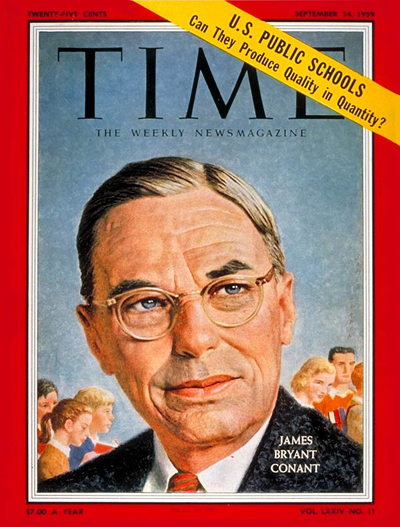
II. Jimmy Conant.  At a practical level, James B. Conant (above) has undoubtedly had a greater organizational affect on education than John Dewey. Conant is perhaps best known for leading the charge for the kind of high school we take for granted today: the comprehensive high school. Reviewing Conant's The American High School Today one contemporary commentator noted the following items of interest:
James B. Conant states as his top priority the elimination fo the small high school, thus joining the legion of modern educators who have fought stoutly for consolidation.
The Report assumes , without questioning that proliferation of many subjects is better than concentration upon fewer, that four of something is necessarily better than two or three, that twenty or more courses during the high school years are better than sixteen, that a seven or eight period day is better than one with a block of time for a core...
The report repeatedly deals with the shadow, not the substance, of the curriculum. ... Almost completely neglected is the crux of the curriculum problem: what goes on within the courses.  
At that last sentence one might heave a sigh of relief: Oh, but we have content standards now - problem solved!. However, the dirty little secret (which Common Core will change not much at all either way) is that standards are merely one link in the chain of communicating content. Whether the weakest link is the teacher, the student or the textbook is perhaps a fruitless argument for another day.

Yet even if content standards did miraculously appear each and every course, the core problem would remain: after four years of high school, how will the average graduate answer the question, What are people for? The approved pedagogical gods at the State level don't bother asking the question so we can only get at their answer(s) by indirection. I'll try to get there by way of Mortimer Adler, so a few words about him first.

 III. Mortimer Adler. If Dewey was concerned with educating for citizenship and "real life," Mortimer Adler's concern was more ambitious but more achievable: give everyone the best possible education. With his emphasis on Big Ideas, Great Ideas, and Great Books, the rotten tomato labelled "elitist" was oft lobbed in his direction. His pithy reply was, "If everyone get this kind of education, it's no longer elitist, is it?" or words to that effect. Adler often credited and quoted Robert Hutchins: The best education for the best is the best education for all. 

If I were to put the question What are people for? to Mortimer Adler, what do I suppose his response might be? I suspect he would reply to be educated. Were I to press him and I'm sure he would humor me, he might very well reply: To be educated means to have an education in the humanities. As I wrote in 1983: "Humanities, as general learning, must include all the subject matters, not just some" (quoted in "Reconstituting the Schools").

All the Subject Matters?

I. An Outline of Knowledge.  In A Guidebook to Learning Adler summarizes what he takes to be an outline of knowledge:

  1. Matter and Energy
  2. Earth
  3. Life on Earth
  4. Human Life
  5. Human Society
  6. Art
  7. Technology
  8. Religion
  9. History of Mankind
  10. The Branches of Knowledge
    1. Logic
    2. Math
    3. Science
    4. History and Humanities
    5. Philosophy

II. California Content Standards.  When this is compared to current California K-12 content standards, we get a very different picture of essential knowledge. Here's a summary of California standards:
English-Language Arts
Mathematics
English Language Development
Career Technical Education (consisting of 15 areas, ranging from Agriculture to Transportation)
Health Education
History-Social Science
School Library Standards (how to research and gather information)
Physical Education
Science
Visual and Performing Arts
World Languages 
Excursus

This excerpt from T.S. Eliot's "Choruses from 'The Rock'" gets at the heart of the matter:

The endless cycle of idea and action,
Endless invention, endless experiment,
Brings knowledge of motion, but not of stillness;
Knowledge of speech, but not of silence;
Knowledge of words, and ignorance of the Word.
All our knowledge brings us nearer to death,
But nearness to death no nearer to God.
Where is the Life we have lost in living?
Where is the wisdom we have lost in knowledge?
Where is the knowledge we have lost in information?

Both Adler's outline and California's standards propose categories of knowledge. There is a wide swath of common ground, but what is missing or superfluous in the California standards according to Adler?

Adler would surely exclude from the category of general learning everything in Career and Technical Education. Missing from the California standards are the following: Religion, Logic and Philosophy.

One can argue for the omission of Religion on all sorts of grounds but the omission cannot be attributed to recent U.S. Supreme Court decisions. The following is a portion of a statement found on the ACLU's website:
Teaching About Religion
5. Students may be taught about religion, but public schools may not teach religion. As the U.S. Supreme Court has repeatedly said, "[i]t might well be said that one's education is not complete without a study of comparative religion, or the history of religion and its relationship to the advancement of civilization." It would be difficult to teach art, music, literature and most social studies without considering religious influences.
The history of religion, comparative religion, the Bible (or other scripture)-as-literature (either as a separate course or within some other existing course), are all permissible public school subjects. It is both permissible and desirable to teach objectively about the role of religion in the history of the United States and other countries. One can teach that the Pilgrims came to this country with a particular religious vision, that Catholics and others have been subject to persecution or that many of those participating in the abolitionist, women's suffrage and civil rights movements had religious motivations.  
Constitutionally permissible but nearly unheard of. Yes, one may find the occasional Bible as Literature or World Religions course but more likely religion is alluded to in a hit or miss fashion in a literature class here or a history course there.

Logic and Philosophy? Much the same.

So, what are people for
according to our public schools?

Wanda the Welder
One can only guess. Pride of place clearly goes to the world of work. But the absence of any emphasis on religion, logic and philosophy clearly indicate an unseriousness (at the state level) of a humanistic, general education. Liberal Arts? Just say No.

Saturday, January 16, 2016

CSET, English, Subtest IV

These Things I Carried ...

Books, notes, and colorful pens

I was flummoxed by my inability to pass the fourth subtest. I generally test well (I achieved the highest possible score on the GRE written exam), so failing the first and then second time were bitter disappointments. The first time I failed, I attributed it to fatigue: after attending to 100 multiple choice questions on literature, textual analysis, composition, rhetoric, language, linguistics and literacy, and two long essays on these same area, I was done. Having to write four shorter responses to unpredictable questions on topics ranging from drama to media to technology to poetry, graphic design, elocution, stage combat, oral interpretation, pantomime and underwater macrame (OK, officially it's only speech communication, journalism/media, drama, and creative writing, which is diverse enough) after hours of testing was akin to taking the Army's PT test consisting of push-ups, sit-ups and a two mile run, and then completing some activities that require fine motor skills such a Jenga and "pick up sticks."

I couldn't blame my second failure on fatigue. I blew it by misreading the directions. I thought I was limited to no more than 125 words per short response but the direction state clearly that the written response should be "approximately, but not limited to, 75-125 words..."  Ugh. Hence I wasted valuable time paring down my responses to this self-imposed limit and failing to attend to having thorough answers.

The Third Try 
Another unacknowledged unvictim of gender bias?

Excursus

I toyed with idea of filing a class-action lawsuit claiming gender bias on behalf of all the other men who have repeatedly failed this subtest, but that didn't seem like a productive use of time. Did you know that in 2009 nearly 70% of the Ph.D.s in English Lit went to women? Or that around 60% of all secondary teachers in the U.S. are female? That's up 5% from 1999. I could not find statistics on percentages of male versus female high school English teachers but I suspect it's close to 25/75 (merely anecdotal: I've subbed for half a dozen female English teachers but only one male).

The unease I experienced taking and preparing again and again for subtest IV is rooted in this: these four domains (speech communication, drama, media/technology, creative writing) require their own set of competencies. On the test one is asked to do two things well: first, to have a firm grasp of theory and practice on each of them; secondly, to be able to summarily articulate how one would approach a problem in each area. The breadth of this task seems to favor women if the observation is valid that women tend to be better generalists and men specialists.

What is the point of this silliness? Merely to say that complaining is much more fun than buckling down and doing the work require.d to complete a task. I'm glad that I chose the route of work instead of complaining ... this time

Let the games begin...

Instead of launching a frivolous lawsuit, I took an online course (more of a set of resources) from the San Diego County Office of Education which proved really useful. It was $40 for the single subtest, but spending money motivated me to take the test seriously.  I also purchased a test preparation book. The resources are only as good as the effort one puts into studying so made flashcards with key terms and ideas, wrote sample responses to sample prompts, and perhaps what proved most important, I racked my brain to remember relevant teaching experiences and anecdotes. 

Notice the missing checkmark beside drama. This lack was evident in the results.

Just the facts, Ma'am... 

For each of the areas (speech, drama, media, creative writing) I made an outline of how I had taught some aspect of the category before. While not exactly having a "canned" answer, I tried to have a grasp of things that could be quickly recalled and applied to potential questions. Interestingly, as seen above, I passed all three of the areas with flying colors but the feedback I got on drama was "lacking support." Hello, I've never taught drama in my whole life nor do I expect I will. 

Preparing for the speech portion, I outlined an experience I had with adults at a parent-teacher night while a middle school teacher. I used this experience during the test. One of my potential media/technology topics was a beautiful Proctor & Gamble commercial for the 2012 Olympics, which I was able to use. Finally, for creative writing (the essay questions are more about editing or teaching writing), I used a comparison of two narration styles used in two chapters of The Things They Carried: third person omniscient in "The Man I Killed" and first person in "Ambush"). As the paper indicates above, I prepared for at least two scenarios for each of the areas. This preparation was very worthwhile. 

Concerning that drama essay, a note I took after the exam reminded me that the essay question was something about an Oscar Wilde play and what I would do to help students be funny or somesuch thing. Hmm...  I had no clue so I was reduced to blowing smoke.


One last hint

While not explicitly recommended, I chose to go back and read (or more accurately, read for the first time)a half dozen  "classic" high school books. This gave me a lot of familiarity with books that might be alluded to on the exam. This didn't have a big impact on the exam but it was important to do anyway. It boosted my confidence a bunch. Another "final" hint: I read and re-read Shakespeare's Hamlet, Tim O'Brien's The Things They Carried, and Steinbeck's Of Mice and Men. 


Why bother anyway? I'm already certificated in Social Sciences... 

My rationale was straight-forward. About 10% of secondary teachers teach history while a full 20% teach English. Demonstrated competency in these two areas makes me theoretically employable for almost 1/3 of the teaching vacancies. Any minute now I'm expecting that call to come with this invitation: Mr. McGuiness, come pick out your classroom!

Sunday, December 20, 2015

CSET, English, Subtest IV

They say the third time is the charm, and I need big medicine to pass this examination. It seems to contain my deepest fears and resentments in the way I think English ought not to be taught: many technical and superficial details without much meaning or depth.

The breadth of these four mini-essays chokes my mind and pulverizes my spirit; I am bereft on the shores of some obscure analogy. Woe, is me!

Finding Positivity 

Facing my fears about English-as-discipline (versus what it primarily is, as a great mentor, Ted Snow, wistfully pointed out to me years ago: a language!) has been useful. At the very least I'm experiencing for myself the anguish that many students face: How do I continue to love literature, art, drama, the spoken word, and, yea, even technological marvels when I am asked to distill all of this greatness into a muddy canal or trickling stream? It seems to be a horror of sorts: to do the thing you love you must first murder it.

The language alive boiled down to bullet points and pragmatic tips for students. I'm no Shakespeare, but I think he too would be horrified. Dare I say that the Bard himself might never have been credentialed to teach English. And yet he is what is Taught!

Nevertheless 

The struggle of preparing has led me to reflect on my two previous failures and understand what is to be done tomorrow. It's a simple matter and for once the criticism of "You're over-thinking this" rings true (Q. Why don't we hear more talk of under-thinking? Isn't that a greater fault?). On my two previous attempts I took the prompts as springboards to wax eloquent about all things tangential. That was my fault.

This time I will stick close to the question and flesh it out thoroughly. No digressions, no chit-chat. Just the facts, ma'am. I possess the knowledge and the ability to demonstrate it. I need only the humility to do what is asked.


Thursday, December 10, 2015

Furniture. Or "Saint Ikea, Pray for Us!"


American society at times seems to hinge upon the thesis that buying stuff is "transformative" and necessary for self-realization, so I hate to aid and abet that point of view. However. However, there is something to be said about classroom space.

By space I mean the physical dimensions of the classroom and the arrangement of furniture and its types. Take the typical seat-desk combo found in many schools:
Exhibit A
Sleek, sturdy but of single purpose. Note the fusion of table top and chair (the wire basket underneath is well-intentioned but becomes merely a place that good lose things or place their trash). With this unity of table and chair, there can be no separation. The unit is heavy, unstackable and expansive.

Here is a better alternative: 
Exhibit B
I have come across only one classroom that uses these but they are in service! Notice the adjustable height for starters. Then check out the space saving design (nothing extends beyond the length of the "feet"). Granted, the military hospital green is little dull, but that is far out-weighed by its practicality:

  • Need space in the center of the room? Stack 'em! 
  • Need a way to section off space in the classroom? Arrange 'em! 
  • Need traditional "rows and columns" for a test? Just do it! 
Why is this important? 

Limitations are manifold in teaching. A simple thing like getting students into the right space for learning ought not to be an obstacle. Exhibit A is filled with peril. Exhibit B allows for creativity and flexibility. 

A dude like John Dewey did not have the limitation of reality when he theorized and laboratorized about education. He could tailor make students and their numbers to suit his purposes. He could cherry pick the raw material and be an artist without the constraints we proletarian teachers face. Alas, I need every edge I can get with a classroom of 40 kids. 

Shared Inquiry Discussion

SID is possible with even 40 students and here's how: Rotate 3 groups of students this way: (1) Inner Circle, (2) Outer Circle, Style feedback, (3) Outer Circle, Content feedback.

It needs some fleshing out but problem is solved in the numbers department. 

I have looked closely at every classroom I've subbed in and asked myself, "Could I run a Socratic seminar in here?" For the vast majority of classrooms the answer has been "Not without a big change in the physical layout!"  Next slide:
Image result for classroom high school packed
Exhibit C
Notice this poor teacher. Not only is he shackled with a man-leash but he must feel a bit claustrophobic. There is no space to move. Nowhere to move the furniture, either. 

"Fulcrum, meet Lever. Lever, Fulcrum."  Enough said. The future belongs to the slim and trim table labeled Exhibit B.


Sunday, November 01, 2015

Movie as Metaphor...for What Ails Education?

The Pentagon Wars is clearly a "B" movie, 

and a nearly humorless comedy at that, but that does not prevent it from having some explanatory power.

The movie is allegedly based on the book by a retired Air Force Colonel who wrote what looks like a serious and detailed study of bureaucratic malfeasance in the Pentagon's procurement process (James Burton, The Pentagon Wars: Reformers Challenge the Old Guard).

Stacked up against such notable classics as Catch-22 or Doctor Strangelove, it surely fails as a "military-lunacy-film," but it does score points in showing how idealists can get co-opted by the system or simply eliminated. The film does seem to leave open the possibility of a "third way" within the system in the character of one Colonel (later Brigadier General) Smith who feeds tidbits of truth to the press and Congress. Yet his timidity suggests this third way to be a compromise that one ought to not consider to remain morally coherent.

The Connection with Education...  

As he was near leaving office, President Eisenhower famously warned of the "military-industrial complex" which could lead to a consumeristic approach to the planning, production and acquisition of war materiel. The film demonstrates how some of the dynamics can work on a small scale. In this case, with the long drawn-out design and testing of what would (finally) become the Bradley Fighting Vehicle.

The education establishment does not consist of generals, but principals, superintendents, professors at schools of education, textbook publishers, lobbyists and politicians. The latter are in abundance and, while they cannot rival the Pentagon's annual budget, education policy and practice far outstrips any cultural contribution the military makes.

And rather than inflated weapons systems that get pushed into the pipeline and have a way of being refined one way or another, the educational schemes that emerge from the "educational-bureaucratic complex" seem to have less "quality assurance" than say, the M16 (one of the best moments of the film is when "Colonel Burton" tells the tale of Vietnam veteran he met who used on the early M16s with the cheap ammo that cost hundreds of lives in the early days of its fielding). When soldiers die, people begin the notice. When educational schemes fail, does anyone notice?


Thursday, September 24, 2015

Substitute Teaching: Entry #1

I'm at roughly the two week point as a substitute teacher in three nearby school districts and it has been an adventure. I've been quite fortunate in that I've been able to (a) work every day I've wanted to, and (b) have good choices with regard to the assignments.

Based on my experiences to date, I have to say that a bit of my pessimism about the fate/future of Western culture/civilization is being rolled back.


Take the foundational document, er, film, The Sandlot. I made reference to it at one of those periodic moments of exasperation and several students replied, "I love that movie." Warm. Fuzzy.

More seriously, I'm finding that students take an interest in what they're studying, and, when conditions are really good (there's the Mystery of Teaching, namely, what creates or allows for these conditions to emerge? Patent that and send the bill to Bill and Melinda or that facebook fool), we engage in real dialogue.

And despite the negative chatter I read about Common Core, kids are reading actual literature and historical texts, not merely IKEA how to assemble instructions (as "real world" as that kind of learning might be -- but is there really a world-wide shortage of those little Swedish Gnomes who make that furniture? I doubt it)! Examples of texts I've read with students recently:

  • Hamlet
  • Jonathan Edwards, "Sinners in the Hands of an Angry God"
  • Harper Lee, To Kill a Mockingbird 
Yes, real literature, real language real transmission of a tradition.


Friday, December 09, 2011

Horace's Compromise

Like Shirer's Rise and Fall, Theodore Sizer's Horace's Compromise was on my "to read" list for some time. I admit that I approached it expecting progressive claptrap about the problem of education being "the man" and how if we can all just learn to get along, education will (some day!) save us from ourselves or other hooey.

On the contrary

This is an amazing book on at least two counts. First, Sizer is able to take his experience of visiting hundreds of schools and distill what are undoubtedly dozens of teachers and students and create composite characters that ring true. Second, Sizer is profoundly realistic about the prospects of meaningful education reform and what that would really mean (versus the babble ABOUT reform coming from all sides).

The prologue alone is worth the price of the book (but it can be found for free at the above link) and I couldn't put it down after reading the prologue. What struck me is how Sizer is able to point out the obvious without condescension or undue criticism: he sees peoples' humanity throughout.

Sizer may not be my new BFF (well, he died two years ago, so that would make it impossible!) but he has given me a lot to chew on. I disagree with him on some things (such as his apparent willingness to equate a secular education with a complete education) but agree whole-heartedly with him on others: teachers must be treated as professionals and as human beings; students must be held accountable and told to figure out more on their own; primacy must be given to the school as a place of intellectual "work" not other things - no matter how noble.

Thoughts - stolen and derived - for a new school

Here's a rough list:
  • Promise to do less but really do it
  • Articulate clearly what is primary and what is secondary, and let the secondary stuff fall away if necessary
  • Avoid at all costs of the never-ending compromise of adding "just one more thing" to teachers' to do lists
  • Writing should be the center of schooling (Hmm, see page 104)
  • Coaching as a task of teachers (and tutors)
  • Teacher to student contact time - keep it somewhere between college professors and what it currently is (gravy, if my counting is right, it was about 32 on paper at MEC - patently absurd, Charlotte & Co.!)
  • Teachers draw out what is inherently interesting in their subjects (versus facile "relevance" or drill and kill)

Much to mull over and explore. Sizer has done something profoundly interesting. May he rest in peace.

Sunday, November 27, 2011

One small step...

It's only what I can conceive of in terms of providence: the Denver Post published a guest commentary by me for their online edition. This is my attempt to articulate the logical connection between school funding and a meaningful education in 21st century America. The full article can be found via the above link.

Thursday, November 24, 2011

"Diverting money from public schools"?

Diane Ravitch repeats the above mantra in the September/October 2011 edition of the Saturday Evening Post. Looking beyond the implied (and utterly false) doctrine that all of God's American children somehow belong to the public schools (a doctrine that was declared unconstitutional in the USSC's decision, Pierce et al. v. Society of Sisters in 1925: parents have the right to raise and educate their children in ways that they see fit and children are not "mere creatures of the State), it is evident that Professor Ravitch is a "glass half empty" kind of person.

One could view the departure of students from public schools as a good thing (in certain cases). We hear about school overcrowding -- what better way to decongest schools than to have some students go elsewhere? Yes, the public school loses some money, but it also has fewer students to teach.

Is Ms. Ravitch of the view that bigger is always better? Is the solution to education problems to maximize the number of students in a district or school in order to have large piles of cash or is the solution to be good stewards of the resources at hand?

The minute we begin looking at children as sources of revenue instead of as human beings, we know we've made a fundamental error.

McEducation

Having criticized Ms. Ravitch, I must here add a point of agreement: the dangers of privatizing education. There is something perhaps ominous about education corporations emerging (well, they already exist) who shoot for instant (albeit short-term) results and big profits at the expense of students and parents. I'm not one who has complete faith in the invisible hand of the free-market.

I taught for three years at a charter high school in the Denver metro area (The New America School, co-founded by the businessman/politician, Jared Polis) and that experience illustrated to me the short-sightedness of the franchise model in education. In particular, the focus on growth and student enrollment.

LinkI recall attending a retreat in which the future of the school was being discussed. I mentioned that I thought the focus should be in establishing a sound pedagogy before pushing for more schools to open. I was in the minority on that one. A minority of one or two.

The corollary to growth is student enrollment (or "the numbers for October count"). This was a particularly shameful spectacle. Two examples:

1. Admitting the wrong kind of students. During my last year at the school we had a new principal who was literally obsessed with maximizing the number of students at the school. I can't recall even one student he advised to elsewhere. When a student comes to enroll with his probation officer, well, one would think one might hesitate about enrolling the student. No, no hesitation. Warm body = $. Violence, expulsion, sexual predator? No problem.

2. Gift cards. That same year the school was giving students $50 gift cards for students who referred friends to the school. They would get the card if the new student stayed through October count. Shameless.

Yes, the privateers can more easily succumb to the temptation to put dollars and cents ahead of pedagogical sense, but it is naive to think public schools are immune from the fixation on the bottom line.

Friday, November 11, 2011

Distracted from distraction by distraction

T.S. Eliot called it a place of disaffection, but young people generally call it "boredom." Somewhere Walker Percy traces the origin of the word to 14th century France. Apparently it's related to the word "to stuff." Thus one who is bored is over-stuffed with something. I witnessed a sample of that "something" recently at a local public library.

LinkA high school student arrived at a vacant desk popped open her binder and began to study (or so I thought). Three or four minutes must have elapsed. She pulled out a cellphone and chattered thus: "What are you doing? Do you want to come to the library? I'm so bored."

There is a wonderful but disturbing scene in Fight Club in which Tyler Durden (Brad Pitt) kisses and then sprinkles "Rupert's" hand with lye. The pain is, of course, unimaginable. Tyler tells Jack: This is the greatest moment of your life and you're off somewhere in La-La Land, missing it.

That is the scene that popped into my head at the library. The ubiquity of technology strips us of patience, which is always a kind of suffering.

Friday, November 04, 2011

The Hubris of Low Expectations

I recall a Catholic retreat I attended in the early '90s while attending Metro State. The theme was "Peace, Peanut Butter and Cooking with Jesus." I'm not even kidding. One can well imagine the content and spirit of such a retreat!

Nevertheless, the retreat was useful in this sense: I met two people who had a benevolent influence on me (Ann Brna and Mike McManus). The latter had this to say: God, we're surrounded by theological midgets! This brief aphorism captured my feelings perfectly. I remember it often when I think of education reform.

Generally one thinks of the hubristic in terms of over-reaching or some form of presumption in the extreme: Hitler waging war on two fronts, Gary Hart daring reporters to follow him around, Bernie Madoff creating his elaborate Ponzi scheme, etc.

But when it comes to public education, we seem to suffer from chronic under-reach: we have no vision but the technical and all of these various techniques (often manipulative of the students) are not related to any other greater meaning. I groan inwardly when I hear teachers emphasizing college for their charges. "Alas," methinks, "Do you think deferring questions of life's meaning is useful for anyone?"

Somewhere Scripture has it: My people die for lack of vision. There's the education crisis in a nutshell: not what and how, but why. Finding the missing why is the key to education reform.

Neil Postman's Contribution

In his penultimate book, Neil Postman made an observation akin to that mythical child who pointed out that the Emperor was wearing no clothes:
At its best, schooling can be about how to make a life, which is quite different from how to make a living. Such an enterprise is not eaasy to pursue, since our politicians rarely speak of it, our technology is indifferent to it, and our commerce despising it. Nonetheless, it is the weightiest and most important thing to write about.

Not everyone agrees, of course. In tracking what people have to say about schooling, I notice that most conversation is about means, rarely about ends. Should we privitize our schools? Should we have national standards of assesment? How should we use computers? What use can we make of television? How shall we teach reading? And so on. Some of these questions are interesting and some are not. But what they have in common is that they evade the issue of what schools are for. It is as if we are a nation of technicians, consumed by our expertise in who something should be done, afraid or incapable of thinking about why (The End of Education, p. x)

He's spot on. We still have all the blather about education reform and nary a peep about ultimate goals (What kind of person should an educated person be? What kind of life is the good life -- irrespective of career choices? What bonds of friendship make life better (or worse)? What kinds of educational systems will facilitate or divert us from answering these questions in a positive way?)

Ah, Neil, I don't know what you believed about ultimate reality, but pray for us! We need all the help we can get.

Thursday, November 03, 2011

Vilifying Voucherites


There is much to criticize in this commentary by John Young in last Sunday's Denver Post, but these four sentences are surely the most egregious:
They want their children associating with "people like me," as opposed to "those people."
And contrary to any other rhetoric, that's the No. 1 reason why some are so dedicated to the concept of school vouchers. It's not about education. It's about association.
There was a radio show from long ago that went something like this: Who knows what evil is in the hearts of men? The Shadow knows. Since he offers absolutely no evidence for this claim, one must conclude it is based upon an assumption or that John Young and The Shadow are really the same person.

Freedom of Association

Even supposing that it is true that some parents have "klannish" or racist intent, is that an argument against vouchers? The medieval maxim puts it this way: The abuse of something does not abrogate its legitimate use. But according Mr. Young freedom of association ought not to be universally available -- at least to parents of modest means.

An Existential Turn

I have no idea what kind of parent Mr. Young is -- did he (or does he) monitor the kind of relationships his kids had at school? Did he suggest that playing with bookish students might be a tad better than hanging out with kids doing meth? Gosh, that would constitute a kind of discrimination now, wouldn't it? Yes, discriminating between caring for a child or neglecting the child.

It is curious that someone who has been awarded recognition on more than one occasion by Planned Parenthood -- that great protector of choice, albeit, oh so narrowly defined -- is so "anti-choice" when it comes to the formation and education of the young. Are we to believe that mothers can be trusted to have their child "associate" with an abortionist in utero but not entrust a mother with that freedom after a child is born?

No, Mr. Young, vouchers are about education and the freedom of parents. Yes, there will be (because there are already) racists in the apple barrel. Such is life and such is the nature of freedom: the ability to make wrong-headed choices.

Why do you want to limit the freedom of parents? Why is it that you support millions in taxpayers' dollars going into that "non-profit" killing machine called Planned Parenthood but utterly reject a few farthings for schools like Christian Valor?

Wednesday, November 02, 2011

Catechetical Films

For Catholic junior/senior high schools students (and other students of good will)
  1. The Apostle (following Christ, human imperfection, forgiveness)
  2. Catch Me If You Can (personal identity, family, relationships)
  3. Contact (faith and reason)
  4. Gattaca (determinism, manipulation of the human)
  5. Groundhog Day (destiny, saying Yes to reality)
  6. Henry Poole Is Here (sacramental economy, meaning, relationships)
  7. King of California (the meaning of 'success,' the nature of paternity, what constitutes a living personality)
  8. Millions (communion of saints, generosity, eternity)
  9. Signs (faith and reason, what faith is/is not)
  10. Strictly Ballroom (the human heart, how the gaze of another transforms one, choosing fear or life)
  11. The Truman Show (the artificiality of modernity and the nature of media; Plato's "Allegory" too)
  12. Unbreakable (fatherhood, acknowledging a plan for one's life, pursuing questions to their end)

Monday, October 31, 2011

Where's "Atheist Academy"?

Alas, even Richard Dawkins is not interested in starting a school for atheists.

Call me cynical, but is it because atheists don't think they themselves believe in anything worth communicating to others? No, the flood of books on the market by these evangelical atheists ("the good news is, life is meaningless") would disprove that theory.

Surely the atheists are morally upright and concerned about the future, and hence about education. Why no charter school with a STEM focus? Or a private school founded by a rich atheist (surely God doesn't just bless the theists!)?

Perhaps the reason is that they are happy with the public schools. Seriously.

Why start a school that incessantly talks about the God Who Isn't (as an atheist school presumably would) when you can send your child to a school that simply ignores that same Non-God? Ideally, an atheist might prefer an Atheist Academy, but Agnostic Public School works just as well and it's a lot more convenient.

Monday, September 19, 2011

Toward a more complete education

I recently began teaching a couple of classes for homeschooling parents looking for some enrichment options for their middle- and high-school aged children. This has me thinking about the feasibility of offering courses specifically for homeschooling families.

The ten percent principle

Well, I don't know if it's a full-blown principle, but the idea is something like this: Catholic high school tuition runs between $7,900.00 and $11,225 in northern Colorado. Suppose you're homeschooling your kids and you realize, "Geez, I can't meet all their needs. A little help would be nice." Would a one day per week program be worth 10% of $10,000? Would $500 per semester be economical enough to consider courses in math, science, religion, etc?

Further, could such a program be made financially worthwhile for prospective teachers? Class size of 15 x $500 = $7,500 divided by four teachers means $1,875 over 15 weeks means $125 per day - which is top-end for what districts will pay a substitute teacher. Materials, rent, and other incidentals also need to be factored in.

It just might work.