Gary Sinise retains the best of the dialogue and gently adapts the story on either end for cinematic purposes. John Malkovich is credible without being maudlin as Lenny, and Sinise does a fine job as George.
A change I didn't like was the substitution of the Luger for Colt or S&W .38. The Luger gave a dark undertone that American revolvers lack. (That's my biggest "complaint" for this fine film)

1973 - when I started asking questions, like, "Why are we all dressed so funny?"
Thursday, December 03, 2015


Book #3 for November 2015
George Orwell, Animal Farm
A good month for reading. Animal Farm is always a treat. I was really struck by the openness of the "dumb" animals to the ideals of Animalism despite evidence to the contrary. Illustrates that politics requires faith, even misplaced faith.
Also, found this sweet little rendition of "Beasts of England" which gives it a bit more contemporaneousness for today's youth.
A good month for reading. Animal Farm is always a treat. I was really struck by the openness of the "dumb" animals to the ideals of Animalism despite evidence to the contrary. Illustrates that politics requires faith, even misplaced faith.
Also, found this sweet little rendition of "Beasts of England" which gives it a bit more contemporaneousness for today's youth.
Sunday, November 22, 2015
Higher Standards or Appropriate Methods?
Recently Overheard:
History is Boring

Regardless of what one thinks of the Common Core standards and their implementation, the truth of the matter is that standards tend to measure (if/when they boiled down to a standardized test) the end, not the means of education.
It's the Methodology, Silly
This semester of substitute teaching has given me the opportunity to informally poll and interview students about their experience of school: the books they read, the way teachers teach, the interaction with their peers, and a host of other topics that are of interest to me professionally (both for a better theoretical understanding of education, but more concretely, of "sizing-up" schools to understand their strengths and weaknesses).
Recently I asked an obviously bright student about history:
Me: What do you think of history?
Her: It's boring. Me: How so? Her: [Shrug] Just a lot of random facts. Me: Really? I find history totally interesting. Do you discuss things? Her: Well, the teacher lectures and we take notes from the book. We do "DBQs" (document-based questions that bring primary documents into focus in order to highlight some part of the historical era under investigation). Sometimes we have a debate, but that's usually 5 students against the rest of the class. Me: Conversations about history or historical questions? Her: No.
I didn't say so, but I thought: If I were in her shoes, I too would be bored out of my skull. Not every class takes a laundry list approach to history, but Common Core or the next placebo that rolls off the assembly line is not going to do much of anything by itself. What is needed is a spirit of Wonder, which is simply a Socratic way of saying "inquiry."
When/if I get the chance to teach history again, Socratic seminars will have pride of place. History is a conversation about reality and what is worth living and dying and fighting for. It's not boring. Only adults who have forgotten their love for reality can make it so.
Book of the Month: November #2
John Steinbeck, Of Mice and Men
How is that English was my favorite subject in high school but I missed so many of these books? Perhaps I was spared them in high school in order that I would truly appreciate them later.
This is the kind of book that can be hijacked to serve a simple politicized goal (from euthanasia to various forms of social justice) or be boiled down to a truism, such as: another case of man's inhumanity to man. But there is something mysterious about it. Having read it only once now, now is not the time to comment on it.
Very rich for a novella but I was left with a kind of sadness. Still, I liked it -- a lot.
Gots to watch one of the movie versions since I've "earned it" by reading the book

How is that English was my favorite subject in high school but I missed so many of these books? Perhaps I was spared them in high school in order that I would truly appreciate them later.
This is the kind of book that can be hijacked to serve a simple politicized goal (from euthanasia to various forms of social justice) or be boiled down to a truism, such as: another case of man's inhumanity to man. But there is something mysterious about it. Having read it only once now, now is not the time to comment on it.
Very rich for a novella but I was left with a kind of sadness. Still, I liked it -- a lot.
Gots to watch one of the movie versions since I've "earned it" by reading the book
Saturday, November 14, 2015
STNG "The High Ground" or Trolling for Relativism?
I have such a love/hate relationship with Star Trek. Gene Roddenberry was clearly both a visionary and a secular humanist on the scale and order of say, John Dewey, which makes him (Roddenberry) an interesting "educator" who suffers not from Dewey's turgid prose.
Here's an episode that can't just decide between good and evil. Are we heading ever upwards to the sunny peaks of progress or will we be bedeviled by our propensity toward violence and self-destruction?

The terrorist leader pictured above -- in desperate need of the ministrations of the Flowbee -- gets his comeuppance from the agile Kerrie Keane who just says No his shenanigans. Meanwhile, Picard and Riker dither and kindly suggest less lethal means for dealing with this shaggy sociopath. Well done, Ms. Keane. You've done the galaxy a favor by going where the men would go neither boldly nor at all. Sometimes it takes a woman to do men's work.
Pope Francis had this to say about the Paris mayhem: "These things are hard to understand. There is no justification for such things. This is not human." Recognizing the inhumanity in a situation is a clarity of judgment that is need now as it will be in the 24th century.
Here's an episode that can't just decide between good and evil. Are we heading ever upwards to the sunny peaks of progress or will we be bedeviled by our propensity toward violence and self-destruction?
The terrorist leader pictured above -- in desperate need of the ministrations of the Flowbee -- gets his comeuppance from the agile Kerrie Keane who just says No his shenanigans. Meanwhile, Picard and Riker dither and kindly suggest less lethal means for dealing with this shaggy sociopath. Well done, Ms. Keane. You've done the galaxy a favor by going where the men would go neither boldly nor at all. Sometimes it takes a woman to do men's work.
Pope Francis had this to say about the Paris mayhem: "These things are hard to understand. There is no justification for such things. This is not human." Recognizing the inhumanity in a situation is a clarity of judgment that is need now as it will be in the 24th century.
Books of the Month: October & November
As I prepare to retake the California Subject Examination for Teachers (English, Subtest IV), I'm reading and/or re-reading some "classic" or at least perfunctory high school texts. For the sake of being better prepared for the four short response (but high stakes!) questions, and just for the fun of it.
October 2015: To Kill a Mockingbird. The first part seems to really drag. Perhaps the way I was reading it or perhaps Harper Lee was getting paid by the word? In either case, it was interesting and generous toward our human complexity. I like the wee lil girl perspective that comes through Scout and her growing awareness of the world as a place far more dangerous and interesting than at first suspects. Yeah, the injustice totally sucks, but we saw that coming. A moral perspective infuses the book: What if you simply can't change the system (for we are all implicated in those systems) and you just have to endure the evil and strive after the good -- what then? Where and how will you stand?
November 2015: William Shakespeare, "Romeo and Juliet." Love Hard, Die Young. What's not to like? Most interesting for me is the sense of redemptive-tragedy. Yeah, the kids die and several of their kin but we don't have the Chorus showing up and saying, "Hey, this is what happens when you mess with the gods." Instead we have the reconciliation (not annihilation!) of the warring clans and the Prince concluding (ironically?):
October 2015: To Kill a Mockingbird. The first part seems to really drag. Perhaps the way I was reading it or perhaps Harper Lee was getting paid by the word? In either case, it was interesting and generous toward our human complexity. I like the wee lil girl perspective that comes through Scout and her growing awareness of the world as a place far more dangerous and interesting than at first suspects. Yeah, the injustice totally sucks, but we saw that coming. A moral perspective infuses the book: What if you simply can't change the system (for we are all implicated in those systems) and you just have to endure the evil and strive after the good -- what then? Where and how will you stand?
November 2015: William Shakespeare, "Romeo and Juliet." Love Hard, Die Young. What's not to like? Most interesting for me is the sense of redemptive-tragedy. Yeah, the kids die and several of their kin but we don't have the Chorus showing up and saying, "Hey, this is what happens when you mess with the gods." Instead we have the reconciliation (not annihilation!) of the warring clans and the Prince concluding (ironically?):
A glooming peace this morning with it brings.
The sun for sorrow will not show his head.
Go hence to have more talk of these sad things.
Some shall be pardoned, and some punished,
For never was a story of more woe
Than this of Juliet and her Romeo.
Would that all strife end in peace.
Sunday, November 01, 2015
Movie as Metaphor...for What Ails Education?
The Pentagon Wars is clearly a "B" movie,

and a nearly humorless comedy at that, but that does not prevent it from having some explanatory power.
The movie is allegedly based on the book by a retired Air Force Colonel who wrote what looks like a serious and detailed study of bureaucratic malfeasance in the Pentagon's procurement process (James Burton, The Pentagon Wars: Reformers Challenge the Old Guard).
Stacked up against such notable classics as Catch-22 or Doctor Strangelove, it surely fails as a "military-lunacy-film," but it does score points in showing how idealists can get co-opted by the system or simply eliminated. The film does seem to leave open the possibility of a "third way" within the system in the character of one Colonel (later Brigadier General) Smith who feeds tidbits of truth to the press and Congress. Yet his timidity suggests this third way to be a compromise that one ought to not consider to remain morally coherent.
The Connection with Education...
As he was near leaving office, President Eisenhower famously warned of the "military-industrial complex" which could lead to a consumeristic approach to the planning, production and acquisition of war materiel. The film demonstrates how some of the dynamics can work on a small scale. In this case, with the long drawn-out design and testing of what would (finally) become the Bradley Fighting Vehicle.
The education establishment does not consist of generals, but principals, superintendents, professors at schools of education, textbook publishers, lobbyists and politicians. The latter are in abundance and, while they cannot rival the Pentagon's annual budget, education policy and practice far outstrips any cultural contribution the military makes.
And rather than inflated weapons systems that get pushed into the pipeline and have a way of being refined one way or another, the educational schemes that emerge from the "educational-bureaucratic complex" seem to have less "quality assurance" than say, the M16 (one of the best moments of the film is when "Colonel Burton" tells the tale of Vietnam veteran he met who used on the early M16s with the cheap ammo that cost hundreds of lives in the early days of its fielding). When soldiers die, people begin the notice. When educational schemes fail, does anyone notice?
and a nearly humorless comedy at that, but that does not prevent it from having some explanatory power.
The movie is allegedly based on the book by a retired Air Force Colonel who wrote what looks like a serious and detailed study of bureaucratic malfeasance in the Pentagon's procurement process (James Burton, The Pentagon Wars: Reformers Challenge the Old Guard).
Stacked up against such notable classics as Catch-22 or Doctor Strangelove, it surely fails as a "military-lunacy-film," but it does score points in showing how idealists can get co-opted by the system or simply eliminated. The film does seem to leave open the possibility of a "third way" within the system in the character of one Colonel (later Brigadier General) Smith who feeds tidbits of truth to the press and Congress. Yet his timidity suggests this third way to be a compromise that one ought to not consider to remain morally coherent.
The Connection with Education...
As he was near leaving office, President Eisenhower famously warned of the "military-industrial complex" which could lead to a consumeristic approach to the planning, production and acquisition of war materiel. The film demonstrates how some of the dynamics can work on a small scale. In this case, with the long drawn-out design and testing of what would (finally) become the Bradley Fighting Vehicle.
The education establishment does not consist of generals, but principals, superintendents, professors at schools of education, textbook publishers, lobbyists and politicians. The latter are in abundance and, while they cannot rival the Pentagon's annual budget, education policy and practice far outstrips any cultural contribution the military makes.
And rather than inflated weapons systems that get pushed into the pipeline and have a way of being refined one way or another, the educational schemes that emerge from the "educational-bureaucratic complex" seem to have less "quality assurance" than say, the M16 (one of the best moments of the film is when "Colonel Burton" tells the tale of Vietnam veteran he met who used on the early M16s with the cheap ammo that cost hundreds of lives in the early days of its fielding). When soldiers die, people begin the notice. When educational schemes fail, does anyone notice?
Religion in the Public School - What's Over the Line?
As a substitute teacher I often find myself giving "micro-lessons". on a topic. Recently I was in a Civics class and they were just beginning a unit on the Bill of Rights. "First things first," thought I. Placing things firmly in the hypothetical, I said, "Let us begin this lesson in the name of the Father and of the Son and of the Holy Spirit, Amen. Brothers and Sisters...."
What's wrong with this picture? I asked. "You can't do that," they said. "Right, so where's MY freedom of religion?" A good discussion ensued from there. Rights, responsibilities, teaching versus indoctrinating, the teacher as representative of the State. In short, a glorious can of worms.
This moment led me to go back and re-read this document: A Teacher's Guide to Religion in the Public Schools which has strange bedfellows ranging from the National Education Association to the National Association of Evangelicals. Well worth a read whether one is religiously inclined or not.

Functionally, the above cartoon may be applied to religion in the public schools in an Orwellian way:
What's wrong with this picture? I asked. "You can't do that," they said. "Right, so where's MY freedom of religion?" A good discussion ensued from there. Rights, responsibilities, teaching versus indoctrinating, the teacher as representative of the State. In short, a glorious can of worms.
This moment led me to go back and re-read this document: A Teacher's Guide to Religion in the Public Schools which has strange bedfellows ranging from the National Education Association to the National Association of Evangelicals. Well worth a read whether one is religiously inclined or not.

Functionally, the above cartoon may be applied to religion in the public schools in an Orwellian way:
IGNORANCE
=
NEUTRALITY
Which would be to not have a grasp of the Court's rulings on the 1st Amendment, religion and the public schools. Sadly, religion does get ignored because it can be contentious, so better ignorance than a hassle, right? Er,...
Saturday, October 31, 2015
Questionable Music: an Alternative to Despair
What happens when students have had three weeks of random substitute teachers?
A flippant response would be, "Nothing good!" That is close to the money, but I had a chance to sub this week for a week's worth of lessons. It's an unfortunate situation when a teacher has an unforeseen situation and it doesn't quite merit a long-term sub. The teacher suffers, the subs suffer, and the students become disoriented and -- some -- become derisive and cynical.
After the second day with these students, it was clear that something beyond worksheets was required. (We had just finished the French Revolution and it seemed to me to be a distinct possibility that if I handed them another worksheet, I might be ascending the steps to the Guillotine!)
The curriculum called for moving into the Industrial Revolution and remember subbing a few weeks before for a psychology teacher in Roseville. I played the video. The video was about memory and how the mind remembers best when there is a context. In the video, one of the shrinks spouted off a set of random numbers and asked us, his audience, to remember them: 1-7-7-6-1-8-1-2-1-8-6-1-1-9-1-4-1-9-4-1, Impossible. But then he said, "American history." Ah, yes, key dates in America history. Easy to remember.
Remembering this, I thought, "How do I give a simple but memorable introduction to the Industrial Revolution?" I found a catchy (or perhaps irritating if you have taste in music) music video on YouTube and two other songs (one on consumerism, the other on oppressive work).
It was more interesting for me than another worksheet. Based on our discussions in class, same for some of the students.
Industrial Revolution Musical Retrospective
A flippant response would be, "Nothing good!" That is close to the money, but I had a chance to sub this week for a week's worth of lessons. It's an unfortunate situation when a teacher has an unforeseen situation and it doesn't quite merit a long-term sub. The teacher suffers, the subs suffer, and the students become disoriented and -- some -- become derisive and cynical.
After the second day with these students, it was clear that something beyond worksheets was required. (We had just finished the French Revolution and it seemed to me to be a distinct possibility that if I handed them another worksheet, I might be ascending the steps to the Guillotine!)
The curriculum called for moving into the Industrial Revolution and remember subbing a few weeks before for a psychology teacher in Roseville. I played the video. The video was about memory and how the mind remembers best when there is a context. In the video, one of the shrinks spouted off a set of random numbers and asked us, his audience, to remember them: 1-7-7-6-1-8-1-2-1-8-6-1-1-9-1-4-1-9-4-1, Impossible. But then he said, "American history." Ah, yes, key dates in America history. Easy to remember.
Remembering this, I thought, "How do I give a simple but memorable introduction to the Industrial Revolution?" I found a catchy (or perhaps irritating if you have taste in music) music video on YouTube and two other songs (one on consumerism, the other on oppressive work).
It was more interesting for me than another worksheet. Based on our discussions in class, same for some of the students.
Industrial Revolution Musical Retrospective
Sunday, October 25, 2015
Star Trek, Immortality and Evasive Action
The name of the German philosopher who claimed that all philosophy begins in the face of death escapes my mind. However, this particular episode (even while being the most anti-theistic I can recall) does show the limits of human development, technology and evolution. The final frontier is not space, but death:

In one of his books Peter Kreeft notes that it is popular to equate religion, magic and superstition as opposed to reason and science. (He then argues that both science and religion are rational, while science and it's manipulative overuse [that which Neil Postman characterized as "Technopoly"]: technology, which he says is a modern version of magic, are fundamentally irrational).
In any case, the above STNG episode reveals more about the Enlightenment Soul of Gene Rodenberry than it does about the future of religion. "Who Watches the Watchers" looks at religion and preaches that men (well, sentient life) simply "evolve" out of religion into rationality and technique. Religion in this view would seem to be - at best - a kind of substitute for science which fades away once a people invents the lightbulb or, say, television.
To go where every man goes...
Despite the episode's superficial and dismissive view of religion, there is a moment rather poignant. After the proto-Vulcans have mistaken Captain Picard for "The Picard, a god," a Federation anthropolgist dies. Confronted with the stark nakedness of death, we hear this bit of dialogue:
I could be reading something into Patrick Stewart, but I had the distinct feeling that even he might have thought that last sentence above was incomplete. I would end it thusly: Perhaps, though, what is inevitable is not annihilation but eternity. There remains so much we don't know....
That would seem to me to be a more scientific view: let the question remain open.
"Who Watches the Watchers"
In one of his books Peter Kreeft notes that it is popular to equate religion, magic and superstition as opposed to reason and science. (He then argues that both science and religion are rational, while science and it's manipulative overuse [that which Neil Postman characterized as "Technopoly"]: technology, which he says is a modern version of magic, are fundamentally irrational).
In any case, the above STNG episode reveals more about the Enlightenment Soul of Gene Rodenberry than it does about the future of religion. "Who Watches the Watchers" looks at religion and preaches that men (well, sentient life) simply "evolve" out of religion into rationality and technique. Religion in this view would seem to be - at best - a kind of substitute for science which fades away once a people invents the lightbulb or, say, television.
To go where every man goes...
Despite the episode's superficial and dismissive view of religion, there is a moment rather poignant. After the proto-Vulcans have mistaken Captain Picard for "The Picard, a god," a Federation anthropolgist dies. Confronted with the stark nakedness of death, we hear this bit of dialogue:
NURIA [the Mitakan leader]: Picard, you could not save her?It is that mortality which calls into question the "Rodenberry Hypothesis" that humanity is always heading onward and upward toward sunlit peaks. We "do have limits" but we desire the limitless. Not merely the "Bad Infinity" of the galaxy or even the universe, but that total satisfaction without end.
PICARD: No.
NURIA: You do have limits. You are not masters of life and death.
PICARD: No, we are not. We can cure many diseases and we can repair injuries, we can even extend life. But for all our knowledge, all our advances, we are just as mortal as you are. We're just as powerless to prevent the inevitable.
I could be reading something into Patrick Stewart, but I had the distinct feeling that even he might have thought that last sentence above was incomplete. I would end it thusly: Perhaps, though, what is inevitable is not annihilation but eternity. There remains so much we don't know....
That would seem to me to be a more scientific view: let the question remain open.
Saturday, October 24, 2015
Shared Inquiry: setting the stage
Just over a year ago I was entering my second year teaching middle school Religion at a Catholic school. The previous academic year I had sporadic success with Shared Inquiry and decided Socratic seminars were something I needed for my own sake -- if not "for the children."
Now I'm firmly convinced that Socratic seminars are not worth doing if they are done poorly. How then to introduce all of the students to this method?

Thank God for the Internet. The Great Books Foundation put out this as part of their introductory materials some years ago but it is still relevant. It gives an overview of a text under discussion ("The Melian Dialogue"), the rationale for Shared Inquiry, the discussion itself, and comments from students after the discussion.
This video helped everyone get on the same page and have a few laughs at the same time. I sometimes give a copy of the selection; other times, I simply summarize the dialogue itself. To help them follow along, I give them some questions to answer and an opportunity to ask questions.
For each section of 6th, 7th and 8th grade I concluded the activity with a question: Do you think you could have conversations like this? If so, do you want to?
Overwhelmingly, kids wanted to. It was a great success. It made AY 2014-2015 more than bearable.
Now I'm firmly convinced that Socratic seminars are not worth doing if they are done poorly. How then to introduce all of the students to this method?
Enter Big Hair Days
Thank God for the Internet. The Great Books Foundation put out this as part of their introductory materials some years ago but it is still relevant. It gives an overview of a text under discussion ("The Melian Dialogue"), the rationale for Shared Inquiry, the discussion itself, and comments from students after the discussion.
This video helped everyone get on the same page and have a few laughs at the same time. I sometimes give a copy of the selection; other times, I simply summarize the dialogue itself. To help them follow along, I give them some questions to answer and an opportunity to ask questions.
For each section of 6th, 7th and 8th grade I concluded the activity with a question: Do you think you could have conversations like this? If so, do you want to?
Overwhelmingly, kids wanted to. It was a great success. It made AY 2014-2015 more than bearable.
Friday, October 23, 2015
One need not "role play"
Before I started the work of being a substitute teacher, I had certain stereotypes in my mind of what a sub was or was not. Most of these were negative. I had literally seen substitute teachers sit and read a book while the students did, well, whatever. I had returned from an absence and seen clear and obvious signs of neglect that were preventable. Most insidious of all, I had my own cherished memories of making life Hell for the poor, unforunate soul who subbed for Mr. Green in 6th grade!
Thus as this stint began I realized I could either "fall into character" and act according to these stereotypes or do something different

Is that you, John Wayne?
It was clear to me that I would not survive if I chose to simply show up and do the minimum. For my own sake I decided that I would focus on the noun, not the adjective in "substitute teacher." It seems to be paying off. Students may be surprised that I plan to work them hard, but I think they are largely relieved. Who likes to waste time? That's really the other option. Especially when you're talking (as most classes seem to be) 80-100 minute block periods.
Move over, Duke! I'm gonna be myself today.
Thus as this stint began I realized I could either "fall into character" and act according to these stereotypes or do something different
Is that you, John Wayne?
It was clear to me that I would not survive if I chose to simply show up and do the minimum. For my own sake I decided that I would focus on the noun, not the adjective in "substitute teacher." It seems to be paying off. Students may be surprised that I plan to work them hard, but I think they are largely relieved. Who likes to waste time? That's really the other option. Especially when you're talking (as most classes seem to be) 80-100 minute block periods.
Move over, Duke! I'm gonna be myself today.
Sunday, October 18, 2015
Flexibility and Finding the Essence
Between improvisation and the punch-list
For some sub gigs, I'm given a veritable punch-list of things to do with students. I appreciate this sometimes: it ensures that we won't be at a loss for what to do. At times it is hard to know how serious the teacher is about the list. Do I have so many things on the list because the teacher really thinks they all ought to be done or is it a kind of "mercy" for the sub to have more than can be accomplished so that the kids will stay busy? I generally take the stance that the teacher has in mind the latter and that getting at least some of these things done is the goal with the perhaps unstated goal being, teach them something.
Flexibility is important.

I try to always find a "hermeneutical key" for both myself and the students. That is, I try to find an idea, theme or phrase that has a seed that has within it an idea that can make sense of the tree. An essential part that makes sense of the bewildering whole. Two examples.
Micro-Case Study #1. I was "thrown-in" to sub for a sub for the first period of a U.S. Government class. After a sentence stem writing exercise, the question of Donald Trump's "suitability" for running for President came up. This led rather directly to questions about how to sort out the best person for the job. Ought it to be something to be sorted out by the system or settled a priori? Good conversation. Essential question: who decides? Pointed to the need for philosophy, for sure.
Micro-Case Study #2. Same day: three sections of World History. Activity: jigsaw elements of French Revolution and the Terror (nine groups). I'm in a bit of logistical hell, here: how to keep kids on task? Well, a struggle but not a failure. The essential question: How did those high ideals of the Enlightenment (Liberty, Equality, Fraternity) turn to the guillotine and buckets of blood?
Questions of meaning are always there.
For some sub gigs, I'm given a veritable punch-list of things to do with students. I appreciate this sometimes: it ensures that we won't be at a loss for what to do. At times it is hard to know how serious the teacher is about the list. Do I have so many things on the list because the teacher really thinks they all ought to be done or is it a kind of "mercy" for the sub to have more than can be accomplished so that the kids will stay busy? I generally take the stance that the teacher has in mind the latter and that getting at least some of these things done is the goal with the perhaps unstated goal being, teach them something.
Flexibility is important.
The Essential
or
"What's the most important thing (in life)?"
Micro-Case Study #1. I was "thrown-in" to sub for a sub for the first period of a U.S. Government class. After a sentence stem writing exercise, the question of Donald Trump's "suitability" for running for President came up. This led rather directly to questions about how to sort out the best person for the job. Ought it to be something to be sorted out by the system or settled a priori? Good conversation. Essential question: who decides? Pointed to the need for philosophy, for sure.
Micro-Case Study #2. Same day: three sections of World History. Activity: jigsaw elements of French Revolution and the Terror (nine groups). I'm in a bit of logistical hell, here: how to keep kids on task? Well, a struggle but not a failure. The essential question: How did those high ideals of the Enlightenment (Liberty, Equality, Fraternity) turn to the guillotine and buckets of blood?
Questions of meaning are always there.
DEATH SENTENCE - Almost as good as Sharknado!
Good Heavens! Rating: 3 out of 5 amputations below the knee

Where does one even begin? This is perhaps the funniest movie I've seen since Sharknado! Granted, with the shark film, I had already braced myself for absurdity but with Death Sentence, I had no idea what kind of film I was getting myself into.
The premise is intriguing: a father witnesses his son getting killed in a random act of gang violence, and decides to take the law into his own hands. This could go in multiple directions, all of them interesting. Moral complexity? Well, the raw material is there but you won't find it here.
What you will find is Kevin Bacon as a kind of Clark Kent miraculously transformed into The Terminator. Professionally, he works for a corporation and seems to be responsible for -- risk management! The film is politely incoherent and all the bad guys get wiped-out (this was not a surprise once I realized the film was not serious).
Special effects are from the George Romero School of Film: a dead cop in the car who has a fountain of blood streaming from his neck; one gang member flies in the air 30' when a car hits him and he's doing just fine in the next scene; another gang guy loses the lower 2/3 of his leg below the knee after a blast from Bacon's 12 gauge shotgun in a moment that is reminiscent of the knight fighting scene from Monty Python's Holy Grail. Rich stuff.
The award for best contrived scene surely goes to the rooftop garage scene where Bacon wraps a seat-belt around a bad guy's neck and the car -- defying gravity as it propels itself up a slope! -- flies off the 3rd level and onto the ground. Sheesh, sometimes seat-belts don't save lives!
There's also a great chase around the house almost as funny as Inspector Clouseau versus Cato in The Pink Panther Strikes Again. The highlight is when Bacon literally pulls the rug from under a bad guy right before he blasts him.
Best unfathomable moment is after Bacon has shot up the town and returns with his rat-scalped self to his now empty house (he has succeeding in getting his wife killed). The lady detective shows up with a convoy of cop cars to his house to ... tell him his remaining son is going to be okay! No arrest, no lecture about going on a killing spree, just good news. Holy Implausibility, Batman!

Not to be missed: the scene where Bacon shaves his head badly and at the same time plays with various guns and ammo. It lasts about ten minutes but the haircut is worth every second.
Look, I know Kevin Bacon, John Goodman, and, yes, Renee Russo all need to make a living, but is this sort of thing really necessary.

Where does one even begin? This is perhaps the funniest movie I've seen since Sharknado! Granted, with the shark film, I had already braced myself for absurdity but with Death Sentence, I had no idea what kind of film I was getting myself into.
The premise is intriguing: a father witnesses his son getting killed in a random act of gang violence, and decides to take the law into his own hands. This could go in multiple directions, all of them interesting. Moral complexity? Well, the raw material is there but you won't find it here.
What you will find is Kevin Bacon as a kind of Clark Kent miraculously transformed into The Terminator. Professionally, he works for a corporation and seems to be responsible for -- risk management! The film is politely incoherent and all the bad guys get wiped-out (this was not a surprise once I realized the film was not serious).
Special effects are from the George Romero School of Film: a dead cop in the car who has a fountain of blood streaming from his neck; one gang member flies in the air 30' when a car hits him and he's doing just fine in the next scene; another gang guy loses the lower 2/3 of his leg below the knee after a blast from Bacon's 12 gauge shotgun in a moment that is reminiscent of the knight fighting scene from Monty Python's Holy Grail. Rich stuff.
The award for best contrived scene surely goes to the rooftop garage scene where Bacon wraps a seat-belt around a bad guy's neck and the car -- defying gravity as it propels itself up a slope! -- flies off the 3rd level and onto the ground. Sheesh, sometimes seat-belts don't save lives!
There's also a great chase around the house almost as funny as Inspector Clouseau versus Cato in The Pink Panther Strikes Again. The highlight is when Bacon literally pulls the rug from under a bad guy right before he blasts him.
Best unfathomable moment is after Bacon has shot up the town and returns with his rat-scalped self to his now empty house (he has succeeding in getting his wife killed). The lady detective shows up with a convoy of cop cars to his house to ... tell him his remaining son is going to be okay! No arrest, no lecture about going on a killing spree, just good news. Holy Implausibility, Batman!
Not to be missed: the scene where Bacon shaves his head badly and at the same time plays with various guns and ammo. It lasts about ten minutes but the haircut is worth every second.
Look, I know Kevin Bacon, John Goodman, and, yes, Renee Russo all need to make a living, but is this sort of thing really necessary.
The MacGyver School of Education
Being a substitute teacher gives daily opportunities for improvisation.

This quotation was given as the warm-up for a series of World History classes:
Success is not final, failure is not fatal: it is the courage to continue that counts. ~Winston Churchill.
I love it when the permanent/regular teacher gives me just enough raw material to do something interesting but not so much that I'm constrained by a kind of punch-list. There is always the possibility of teaching a bit of something, be it historical background or human frailty.
This quotation was a springboard into the live of Winston Churchill during one class period (a slightly abridged version of his life and times). Fortuitously, I had recently read Roy Jenkins' Churchill.

Jenkins really brings out Churchill's virtues and vices, his triumphs and defeats. A man, a fallen man, a great man. For one class, I went a bit overboard in my peregrinations. I noted that despite his gargantuan ego and other unlikable qualities, Winston was a man who could see through Hitler. It might be (or not) an overstatement to say he was responsible for saving Europe (and hence, North America) from totalitarianism, but his rise to Prime Minister meant that England held the line against the Nazi war machine and Hermann Goering's incompetence was brought to light. The Battle of Britain was a turning point, though this was not obvious at the time.
Yet having so much background knowledge can take me over the line. Alas, I had a bit of a "Smokey" moment... [viewer discretion advised]
I had gone on and on (Over the line!), and then set the students to work on their jigsaw activity on the French Revolution. Time is a finite quantity and when I called "Time," a shy but intelligent girl pointed out, "We spent too much time on the warm-up, and we need more time to complete our piece of the revolution." Indeed. Well, "Walter" has taught me that when the facts of the case are clear, one bows to reason despite the desire to press ahead. I gave the class a more reasonable amount of time to complete their tasks.
This quotation was given as the warm-up for a series of World History classes:
Success is not final, failure is not fatal: it is the courage to continue that counts. ~Winston Churchill.
I love it when the permanent/regular teacher gives me just enough raw material to do something interesting but not so much that I'm constrained by a kind of punch-list. There is always the possibility of teaching a bit of something, be it historical background or human frailty.
This quotation was a springboard into the live of Winston Churchill during one class period (a slightly abridged version of his life and times). Fortuitously, I had recently read Roy Jenkins' Churchill.
Jenkins really brings out Churchill's virtues and vices, his triumphs and defeats. A man, a fallen man, a great man. For one class, I went a bit overboard in my peregrinations. I noted that despite his gargantuan ego and other unlikable qualities, Winston was a man who could see through Hitler. It might be (or not) an overstatement to say he was responsible for saving Europe (and hence, North America) from totalitarianism, but his rise to Prime Minister meant that England held the line against the Nazi war machine and Hermann Goering's incompetence was brought to light. The Battle of Britain was a turning point, though this was not obvious at the time.
Yet having so much background knowledge can take me over the line. Alas, I had a bit of a "Smokey" moment... [viewer discretion advised]
I had gone on and on (Over the line!), and then set the students to work on their jigsaw activity on the French Revolution. Time is a finite quantity and when I called "Time," a shy but intelligent girl pointed out, "We spent too much time on the warm-up, and we need more time to complete our piece of the revolution." Indeed. Well, "Walter" has taught me that when the facts of the case are clear, one bows to reason despite the desire to press ahead. I gave the class a more reasonable amount of time to complete their tasks.
Monday, September 28, 2015
Substitute Teaching: Entry #2
Today I was at a small school that reminded me of Mapleton Early College in Denver. A very, very different teaching and learning environment than Thursday and Friday of last week. The commonality? One can be "present" despite the different needs of the students. I only one or two inquiries about the text itself (Unbroken) but I kept myself open and available.
I proposed that work on the text together as a class but they preferred to work on their own (not once, but three discrete classes). Well, maybe next time...
I proposed that work on the text together as a class but they preferred to work on their own (not once, but three discrete classes). Well, maybe next time...
Thursday, September 24, 2015
Substitute Teaching: Entry #1
I'm at roughly the two week point as a substitute teacher in three nearby school districts and it has been an adventure. I've been quite fortunate in that I've been able to (a) work every day I've wanted to, and (b) have good choices with regard to the assignments.
Based on my experiences to date, I have to say that a bit of my pessimism about the fate/future of Western culture/civilization is being rolled back.

Take the foundational document, er, film, The Sandlot. I made reference to it at one of those periodic moments of exasperation and several students replied, "I love that movie." Warm. Fuzzy.
More seriously, I'm finding that students take an interest in what they're studying, and, when conditions are really good (there's the Mystery of Teaching, namely, what creates or allows for these conditions to emerge? Patent that and send the bill to Bill and Melinda or that facebook fool), we engage in real dialogue.
And despite the negative chatter I read about Common Core, kids are reading actual literature and historical texts, not merely IKEA how to assemble instructions (as "real world" as that kind of learning might be -- but is there really a world-wide shortage of those little Swedish Gnomes who make that furniture? I doubt it)! Examples of texts I've read with students recently:
Based on my experiences to date, I have to say that a bit of my pessimism about the fate/future of Western culture/civilization is being rolled back.
Take the foundational document, er, film, The Sandlot. I made reference to it at one of those periodic moments of exasperation and several students replied, "I love that movie." Warm. Fuzzy.
More seriously, I'm finding that students take an interest in what they're studying, and, when conditions are really good (there's the Mystery of Teaching, namely, what creates or allows for these conditions to emerge? Patent that and send the bill to Bill and Melinda or that facebook fool), we engage in real dialogue.
And despite the negative chatter I read about Common Core, kids are reading actual literature and historical texts, not merely IKEA how to assemble instructions (as "real world" as that kind of learning might be -- but is there really a world-wide shortage of those little Swedish Gnomes who make that furniture? I doubt it)! Examples of texts I've read with students recently:
- Hamlet
- Jonathan Edwards, "Sinners in the Hands of an Angry God"
- Harper Lee, To Kill a Mockingbird
Yes, real literature, real language real transmission of a tradition.
Wednesday, May 22, 2013
Glenn Beck, Nihilist
If you're like me, when you hear "nihilist" you think of someone like Friedrich Nietzsche (as a dapper young man, below), not a radio personality such as Glenn Beck.
 But today I thought of Mr. Beck as deeply nihilistic when I listened to his radio show. I confess to a certain fascination in listening to his show. He puts me in a bit of trance actually, and on some commutes, that's nice.
What's not nice is nihilism. Without being overly pedantic, nihilism is the philosophical (and religious) conclusion that everything is, in the final analysis, meaningless. Meaningless because there is no substance to reality; only transitory impressions and bodies that carry them, and then they all fade to black.
Atheism isn't really the main point (though it certainly implies atheism and an atheist would need to struggle mightyly not to view reality nihilistically.
Perhaps a film clip would help. Lacking that, there is a bit of brilliant dialogue: In Signs, Mel Gibson's Father Hess (how's that for a pair of opposites!) has concluded that "There is no one watching out for us; we are all on our own."
Life, death, love, beauty, justice, goodness and desire all absurd and destined to die with our deaths. Cheers!
Mr. Beck's Nihilism.
Now I don't know exactly Glenn Beck's religion or particular denominational flavor, but functional nihilism is certainly compatible with a belief in God. Functional nihilism is similar to Pelagianism in the moral life: Jesus is an example for us, but we must struggle mightily (and alone!) to perfect ourselves. Beck seems to takes this view and transpose it to the social and political order.
The nothingness in Mr. Beck's world is indicated by the word "we."
Being, not being busy.
Albert Borgmann in Holding on to Reality notes that hyperactivity and sullenness go hand-in-hand. Just watch a teenager after playing 12 hours of Halo or somesuch. Busyness is not just for teens and the emptiness that drives busyness is pandemic in our culture today.
At the heart of emptiness lies nihilism: the conclusion that the alternatives are perpetual stimulation or despair from the yawing abyss inside. The wonder of nihilism is that one can be infected and not even realize it.
Fortunately or not, the truth is that we (there I go!) can't save ourselves, and we can't give ourselves life. Sorry, Mr. Beck, something deeper is at the heart of reality. When we pay attention to that we become fruitful.
 But today I thought of Mr. Beck as deeply nihilistic when I listened to his radio show. I confess to a certain fascination in listening to his show. He puts me in a bit of trance actually, and on some commutes, that's nice.
What's not nice is nihilism. Without being overly pedantic, nihilism is the philosophical (and religious) conclusion that everything is, in the final analysis, meaningless. Meaningless because there is no substance to reality; only transitory impressions and bodies that carry them, and then they all fade to black.
Atheism isn't really the main point (though it certainly implies atheism and an atheist would need to struggle mightyly not to view reality nihilistically.
Perhaps a film clip would help. Lacking that, there is a bit of brilliant dialogue: In Signs, Mel Gibson's Father Hess (how's that for a pair of opposites!) has concluded that "There is no one watching out for us; we are all on our own."
Life, death, love, beauty, justice, goodness and desire all absurd and destined to die with our deaths. Cheers!
Mr. Beck's Nihilism.
Now I don't know exactly Glenn Beck's religion or particular denominational flavor, but functional nihilism is certainly compatible with a belief in God. Functional nihilism is similar to Pelagianism in the moral life: Jesus is an example for us, but we must struggle mightily (and alone!) to perfect ourselves. Beck seems to takes this view and transpose it to the social and political order.
The nothingness in Mr. Beck's world is indicated by the word "we."
- We must do this.
- We must join him now to do that.
- If we don't do something now, what-have-you will happen.
Being, not being busy.
Albert Borgmann in Holding on to Reality notes that hyperactivity and sullenness go hand-in-hand. Just watch a teenager after playing 12 hours of Halo or somesuch. Busyness is not just for teens and the emptiness that drives busyness is pandemic in our culture today.
At the heart of emptiness lies nihilism: the conclusion that the alternatives are perpetual stimulation or despair from the yawing abyss inside. The wonder of nihilism is that one can be infected and not even realize it.
Fortunately or not, the truth is that we (there I go!) can't save ourselves, and we can't give ourselves life. Sorry, Mr. Beck, something deeper is at the heart of reality. When we pay attention to that we become fruitful.
Thursday, May 09, 2013
Blue Like Jazz
 If you're like me, every time you hear "Christian movie," you reach for a jug of Pepto-Bismol (and maybe some holy water, for good measure).
With rare exception, most are deplorable. Christ is not glorified, but dare I say, horrified.
If you get the DVD of Blue Like Jazz, you may want to fast forward through the trailers. They are "Exhibit 'A'" of horrendous "Christian" movies.
Thus my expectations were very low when watched Blue Like Jazz, but I was pleasantly surprised. It did what the stereotypical Christian movie can't quite get itself to ever do: stay close to human experience.
You know what I mean: the Christian film that begins with a premise of what life ought to be "from a biblical perspective" (does the Bible have eyes?) and then simply transposes this ideology into the realm of dialogue and wooden acting.
Granted, having good intentions and thinking this is enough to make a good film is not the folly of just Christians (but it seems to "help"): Freedom Writers nearly drove me to violence with its sweetness-unto-death.
Blue Like Jazz does something that is rarely recognized in film (or anywhere else in popular culture). It acknowledges the failure of Christians but insists upon the power of Christ. Now that sounds all pious, doesn't it? But what I mean is that it puts on display evangelical (well, Southern Baptist) absurdities, but in so doing it does not dismiss the religious questions at the heart of religion (the questions of Southern Baptists, too!).
The film suggests that scandal does not dispense one from seeking out the meaning of life.
Donny's struggle is any thinking person's struggle: how do I reconcile the disproportion between who Christ is and the radical deficiencies of Christians? The film seems to answer it by saying, You don't. That is, the mystery of sin and evil are not problems to be solved, but are mysteries at the depths of each of our hearts.
Living as if God doesn't exist, doesn't solve the problem of sin and evil. As the saying goes, "Where ever you go, there you are."
The film touches upon the themes of scandal, friendship, higher education and meaning. A perfect film? No. But certainly one that can be enjoyed and re-watched. No Pepto-Bismol required.

Tuesday, May 07, 2013
I Dreamt of Jello
I know what you're thinking: "No way! Too far!"
 They say that the raw material for one's dreams comes from everyday experience.
The night before I watched a bit too much of Jello, Ice-T and others on an Oprah episode from way back.
Jello was there with a vengeance in my dreams that night.
I knew it was a dream because Jello was listening to me.
We were at a bar and I was telling him how I credited him with part of my return to Christianity -- Catholicism in particular.
He took it really well.
I thought then (the late 1980s) and still stand by it: punk was asking the right kinds of questions. Sure, the questions generally don't ascend beyond the sociological, but still, in many ways DK was on the right track.
Here's but one example (on the nature of work): "Soup is Good Food"* treats the nature of work and the evils of treating people as disposable. It's a great song, but what's missing? Well, in a word or two: hope, transcendence, meaning. The negative is there (which is not nothing -- in an age where Original Sin is vilified or ignored), but what is the "ought" that ought to be there?
That's why punk ultimately fails. One needs not perpetual cheerfulness but reality. Neither optimism nor unbridled pessimism, but simply the whole truth of the human condition.
He will surely laugh and scoff, but I pray for Jello.
*CAUTION: The song has some naughty words.
 They say that the raw material for one's dreams comes from everyday experience.
The night before I watched a bit too much of Jello, Ice-T and others on an Oprah episode from way back.
Jello was there with a vengeance in my dreams that night.
I knew it was a dream because Jello was listening to me.
We were at a bar and I was telling him how I credited him with part of my return to Christianity -- Catholicism in particular.
He took it really well.
I thought then (the late 1980s) and still stand by it: punk was asking the right kinds of questions. Sure, the questions generally don't ascend beyond the sociological, but still, in many ways DK was on the right track.
Here's but one example (on the nature of work): "Soup is Good Food"* treats the nature of work and the evils of treating people as disposable. It's a great song, but what's missing? Well, in a word or two: hope, transcendence, meaning. The negative is there (which is not nothing -- in an age where Original Sin is vilified or ignored), but what is the "ought" that ought to be there?
That's why punk ultimately fails. One needs not perpetual cheerfulness but reality. Neither optimism nor unbridled pessimism, but simply the whole truth of the human condition.
He will surely laugh and scoff, but I pray for Jello.
*CAUTION: The song has some naughty words.
Sunday, May 05, 2013
In praise of ambiguity
It's a curious thing: I'm listening to some music I haven't listened to for years. The curious thing is that what "turned me off" years ago is precisely why I find it so interesting now.
Here's an example from Daniel Amos' album Kalhoun.
(Yes, literate reader, the lyrics are not that ambiguous, but for me, ascending the heights of enlightenment are arduous!)
But this ambiguity also applies to bands like U2, The Call, The 77s and others. It opens a space, a human space.
It is perhaps that becoming an adult means the refusal of fundamentalism? Perhaps.
Here's an example from Daniel Amos' album Kalhoun.
(Yes, literate reader, the lyrics are not that ambiguous, but for me, ascending the heights of enlightenment are arduous!)
But this ambiguity also applies to bands like U2, The Call, The 77s and others. It opens a space, a human space.
It is perhaps that becoming an adult means the refusal of fundamentalism? Perhaps.
Sunday, April 21, 2013
The Holy Legion of Diana Moon Glampers
I came across an article in First Things that lamented the lack of substantive guidance concerning film found on the American bishops' website. For some reason this got me thinking of Diana Moon Glampers (the portly, matronly villain in Kurt Vonnegut's "Harrison Bergeron").
This story is common in public secondary schools here in the States, but in case you've forgotten the tale, here's the climax:
The Legion of Deceny had the best of intentions: filth ran rampant in film (for the 20s and 30s, that is) and they created a simple rating system that was meant to protect pious hearts, minds and eyes from temptation. What has always made me curious about this approach is the censor (or "guidance counselor" if you prefer): how is he protected from the filth? Is he like an exorcist who has a designated role in which he gets special protection? In other words, doesn't the censor endanger his own soul?
In this I'm reminded of a friend who recounts that the private Christian school she went to had a cheer-leading squad. After each game, the principal and assistant principal (two white guys) would review footage of the girls performance to ensure that their short dresses were of appropriate length as they "reeled, whirled, swiveled, flounced, capered, gamboled, and spun." Yeah, protecting everyone's morals, I'm sure.
Censors of the soul (and body) are alive if not well. For all I know, they are legion.
Permission granted
In film, fiction and other areas of creative expression, some look for someone else's permission to view or read certain works. I can sympathize with this at one level: in our hyperactive age, it seems that one simply doesn't have the time to judge for oneself. Alas, the price of the shortcut (trusting in the wisdom of the impeccably safe expert) is alienation. But wait, there's more: you also get absolution from responsibility engaging the world with all of its ambiguity. Disengagement is magically transformed into piety and virtue. I call that a bargain.
Without a willingness to take risks, it is impossible to mature. And maturing is simply the fruit of being edcuated - continually. I have had parents complain that the text I assigned or the film I showed was scandalous or too suggestive or simply "too confusing" for their son or daughter. I think they are often being a bit disengenous when they say this. For all I know, it's true: their son or daughter doesn't "get it," but the punchline is that neither does mom or dad. That's the real problem: mal-educated parents who are unwilling to try to understand.
I should note that in none of these cases did the works appeal to prurient interests nor did they contain an excess of nudity or gratuitous violence. I'm very circumspect in what I share with students.
So, what's going on here? Am I watching the "dumbing down of America" before my eyes?
My pet theory is that there are a lot of good, faithful Catholics who simply want to be spared the drama of interpretation. This is where the censors or gurus or experts come in: they certify content for us. Their slogan could be, "We think so you don't have to!"
T.S. Eliot warns of this pathology:
This story is common in public secondary schools here in the States, but in case you've forgotten the tale, here's the climax:
Harrison placed his big hands on the girl’s tiny waist, letting her sense the weightlessness that would soon be hers. And then, in an explosion of joy and grace, into the air they sprang!Poor Ms. Glampers! As in her (future) day as today, people so often want the end without a messy means. In this story "we the people" want absolute equality and the enforcement mechanism is a horror.
Not only were the laws of the land abandoned, but the law of gravity and the laws of motion as well.
They reeled, whirled, swiveled, flounced, capered, gamboled, and spun.
They leaped like deer on the moon.
The studio ceiling was thirty feet high, but each leap brought the dancers nearer to it.
It became their obvious intention to kiss the ceiling.
They kissed it.
And then, neutralizing gravity with love and pure will, they remained suspended in air inches below the ceiling, and they kissed each other for a long, long time.
It was then that Diana Moon Glampers, the Handicapper General, came into the studio with a double-barreled ten-gauge shotgun. She fired twice, and the Emperor and the Empress were dead before they hit the floor.
The Legion of Deceny had the best of intentions: filth ran rampant in film (for the 20s and 30s, that is) and they created a simple rating system that was meant to protect pious hearts, minds and eyes from temptation. What has always made me curious about this approach is the censor (or "guidance counselor" if you prefer): how is he protected from the filth? Is he like an exorcist who has a designated role in which he gets special protection? In other words, doesn't the censor endanger his own soul?
In this I'm reminded of a friend who recounts that the private Christian school she went to had a cheer-leading squad. After each game, the principal and assistant principal (two white guys) would review footage of the girls performance to ensure that their short dresses were of appropriate length as they "reeled, whirled, swiveled, flounced, capered, gamboled, and spun." Yeah, protecting everyone's morals, I'm sure.
Censors of the soul (and body) are alive if not well. For all I know, they are legion.
Permission granted
In film, fiction and other areas of creative expression, some look for someone else's permission to view or read certain works. I can sympathize with this at one level: in our hyperactive age, it seems that one simply doesn't have the time to judge for oneself. Alas, the price of the shortcut (trusting in the wisdom of the impeccably safe expert) is alienation. But wait, there's more: you also get absolution from responsibility engaging the world with all of its ambiguity. Disengagement is magically transformed into piety and virtue. I call that a bargain.
Without a willingness to take risks, it is impossible to mature. And maturing is simply the fruit of being edcuated - continually. I have had parents complain that the text I assigned or the film I showed was scandalous or too suggestive or simply "too confusing" for their son or daughter. I think they are often being a bit disengenous when they say this. For all I know, it's true: their son or daughter doesn't "get it," but the punchline is that neither does mom or dad. That's the real problem: mal-educated parents who are unwilling to try to understand.
I should note that in none of these cases did the works appeal to prurient interests nor did they contain an excess of nudity or gratuitous violence. I'm very circumspect in what I share with students.
So, what's going on here? Am I watching the "dumbing down of America" before my eyes?
My pet theory is that there are a lot of good, faithful Catholics who simply want to be spared the drama of interpretation. This is where the censors or gurus or experts come in: they certify content for us. Their slogan could be, "We think so you don't have to!"
T.S. Eliot warns of this pathology:
They constantly try to escapeI don't think that Catholics in America are so obtuse that we need a revitalized Legion of Decency (such travesties can be entrusted to our evangelical friends!); what we need to do is to begin educating ourselves. In no little part, this is why the Church exists for us.
From the darkness outside and within
By dreaming of systems so perfect that no one will need to be good (Choruses from "The Rock").
Wednesday, April 17, 2013
Am I wrong? Am I wrong?! ("No, Walter, you're not wrong, you're just an ...")
Are today's fashions something new? Nah, just recycled from back in the day. Check it: fashun
Finding Emo OR "Have you no sense of deceny, sir?"
This is perhaps the kind of thing one might expect on The Phil Donahue Show (my generation) or Oprah Winfrey or what have you. To see our President use his office as a platform for such emotional pandering is sickening.
Here's the segment.
I don't blame Mrs. Wheeler or her husband. If such evil befell me and mine, I'm sure I want to do whatever I thought might be constructive. Nevertheless.
The basis for political discourse is not "emotionality" (see Sergeant Lincoln Osirus/Kirk Lazarus/Robert Downey, Jr.) but a reasoned conversation. This is precisely the kind of excess of the passions that Socrates feared. In his trial (see "The Apology" by Plato) he refused to bring in his family as part of his defense. He said that to do so would be to distort Justice. He wouldn't pander.
Obviously, not even the "Narcissist-in-Chief" equates himself with Socrates, but he could get a clue from him. If emotionality is what you got, you ain't got much.
It would be constructive to use research, statistics and data in the gun control debate, but we'll see continue to see overblown rhetoric on both sides.
Bedtime for Democracy.
P.S.
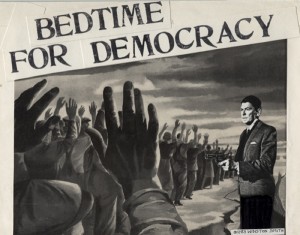
Love him or hate him, gotta LOVE Jello's wry sense of humor
Sunday, April 14, 2013
That which we (good Catholics) don't speak of
In his fascinating study of violence, scripture and culture, Gil Bailie notes that "myth" is related a word that means silence or shut up (see Violence Unveiled). Thus in M. Night Shyamalan's The Village, the boogeymen become "Those We Don't Speak Of." In Catholic circles there are some things we don't speak of. Here's a short list of vexation (emendations and footnotes could certainly be added):
- Good intentions are enough (TWDSO: the results are deplorable - in art, music and most every form of cultural engagement). Question: Where are our Walker Percys, Flannery O'Connors and Graham Greenes? Answer: Nowhere to be seen on the cultural stage.
- We no longer have an Index of Forbidden Books (TWDSO: we have a cramped version of Catholic orthodoxy that insists only certain authors ought to read; put differently, we [the laity] lack the critical skills to discern good from bad so we outsource our responsibility to "safe" sources).
- Social justice has made great strides (TWDSO: we underpay lay church workers and justify it with recourse to a spiritualized justification). Ah, yes, Who Would Jesus Exploit? Hello! The social teaching of the Church applies to the Church herself. Duh!
- Education is something we do to / for others (TWDSO: we think we have the answers and that we can thus convert them [da pagans], missing the need for introspection -- not to speak of motes and planks!). How many Catholic institutions are merely secular with Jesus as window dressing? Christ should inform every aspect of our teaching and evangelization efforts. Yet we often revert to a kind of Protestant evangelism (tell about Jesus and let Jesus extract them out of the world) versus authentic evangelization (education of the whole person, in his/her circumstances in life and the tools to be salt and light). I need it, you need it, we all need it.
- Scandal is everywhere (TWDSO: much truth is left unsaid and we end up preaching only to "the choir."). The question becomes, "Is it safe?" (a la Marathon Man!) not "Is it true?"
Thursday, April 11, 2013
Fairly imbalanced: the Denver Post on gun control
 Dear Editor,
One continually finds reference to the
ominous "gun lobby" in the pages of the Denver Post, but
not much is said about the anti-gun lobby. I've wondered why. Then I
opened today's op-ed pages and found what might be the explanation:
the anti-gun lobby is you, Denver Post. Well, if you are not the
anti-gun lobby, you are definitely a key and influential
sympathizer.
How else does one explain two op-ed pieces, three letters to the editor and two cartoons excoriating, mocking and demonizing the pro-gun side against one sly pro-gun letter?* 1500 words to a mere 80. This betokens not only advocacy for gun prohibition (yeah, that worked real good before; even “better” than the War on Drugs) but a deep-seated fear. This is America, so you can advocate for whatever you want but hysteria is no way to run a newspaper. Coloradans of all political persuasions deserve better.
How else does one explain two op-ed pieces, three letters to the editor and two cartoons excoriating, mocking and demonizing the pro-gun side against one sly pro-gun letter?* 1500 words to a mere 80. This betokens not only advocacy for gun prohibition (yeah, that worked real good before; even “better” than the War on Drugs) but a deep-seated fear. This is America, so you can advocate for whatever you want but hysteria is no way to run a newspaper. Coloradans of all political persuasions deserve better.
*Note: You can find all of the anti-gun pieces on the Denver Post website, but here's a sample.
Wednesday, April 10, 2013
Political Pitfalls
I've recently becoming engaged in
writing my senators and congresspeople (state and federal) over
proposed new laws concerning firearms. I'm a bit scandalized that it
was this issue that awoke me from my political slumbers, but perhaps
we can't choose what will serve as a spark to get us moving. In the
process of listening to right and left debate the issue, and watching
myself become involved, it has become clear that both sides not only
reduce the issue to opposing soundbites, but also reduce the humanity
of the opposition.
Here in Colorado, one agitated pro-gun
guy left a nasty voice-mail for a female African American
representative in which he hoped for her violent demise; on a
national lefty talk show, Randi Rhodes opined that gun manufacturers
don't care how many innocent people die by the abuse of their product
as long as they make a profit.
Emotions are a wonderful thing. They
can draw us closer to reality (think of how love allows one to better
see the beloved). They can also have the opposite effect: they can
occlude reality and make us disconnected from others.
Party of God?
When it came to
political activism, Jesus never met people's expectations. In Jesus'
day as in our own, there were plenty of “leaders” who had all the
answers but misconstrued the questions. In St. Mark's gospel we read
of this example:
And they sent to him some of the
Pharisees and of the Herodians; that they should catch him in his
words. Who coming, say to him: Master, we know that thou art a true
speaker, and carest not for any man; for thou regardest not the
person of men, but teachest the way of God in truth. Is it lawful to
give tribute to Caesar; or shall we not give it? Who knowing their
wiliness, saith to them: Why tempt you me? bring me a penny that I
may see it. And they brought it him. And he saith to them: Whose is
this image and inscription? They say to him, Caesar' s. And Jesus
answering, said to them: Render therefore to Caesar the things that
are Caesar' s, and to God the things that are God' s. And they
marvelled at him.
Jesus doesn't give them an answer and
yet He does give them the opportunity to face the question in the
right way.
In America today, there is no lack of
answers, but there is an abysmal absence of thoughtful questions.
Democrats and Republicans count of the people's ignorance and sloth
to win votes and the media gleefully repackages these political
reductions of reality.
From gun-control to education to
“sexual health,” seemingly everyone is willing to demonize the
opposition and reduce debate to a shouting match. In
such an environment, one could retreat to a cozy apolitical ghetto.
Or one could decide to be a protagonist.
The recovery of the human
Antagonists and
antagonisms are never lacking. The question is not really What would
Jesus do? but How do I face the whole of reality? (and this includes
the political). This is a personal work that cannot be placed on the
shoulders of others – no matter how correct we view their
positions. Catholics in America need fewer gurus, not more. Ours is
an age of alleged experts and this applies to the ecclesial and
secular environments. This does not mean that others cannot be
witnesses or guides for us; it simply means we need to take seriously
the personal responsibility that being Christian is.
Perhaps what
Catholics can bring into the public square is not necessarily better
answers, but to see and bear witness to the questions that lie at the
heart of our political dis-ease. Of the need for this, one can simply
think of how one views the opposition (of whatever sort): are they
even human?
Getting back to my
vexation over the gun-control issue above, I can assure you that I've
had moments of doubt about the humanity of political opponents. In
short, it's been quite easy to shift from seeing them as folks made
in the image and likeness of God to viewing them as hostile
matriarchs and metrosexuals trying to “take ma guns away from me.”
But this way of thinking is useless.
For real political
progress to occur in America, there needs to be acknowledgment of our
human needs and our solidarity with others, regardless of party or
politics.
Fr.
Julián
Carrón recently noted that in Europe politicians are “more defined
by party alignments than by self-awareness of their ecclesial
experience and the desire for the common good” (La Repubblica, 10
April 2013). Our recent national election bears out that this is true
not only for politicians, but for the electorate as well.
We
don't need more political parties, but we do need to attend to what
is most human in ourselves and in others.
Sunday, March 24, 2013
In defense of the NRA
On the op-ed pages of the Denver Post,
the National Rifle Association has become the organization that
seemingly everyone loves to hate. Never mind the fact that the NRA is
the organization doing the most good in terms of firearms education,
safety and training. Ask most any law enforcement officer and chances
are that she was trained by an NRA-certified instructor.

Overlooked in all the NRA-bashing of
late is the history of the organization (readily available on their
website and from independent sources as well). Most folks don't know
that the NRA has supported the regulation of machine guns, tighter
restrictions on the importation of some arms and the “insta-check”
system now used by federally licensed firearms dealers.
If the NRA seems intransigent
concerning new gun laws it may simply be that they have reached the
conclusion that (1) we have enough reasonable gun laws right now and
(2) that the goal of those pushing for new laws is unilateral
disarmament.
Mental defectives, drug addicts and
felons are already prohibited from purchasing firearms. These
prohibitions did not prevent either James “Bad Hair” Holmes or
Adam Lanza from committing their atrocities, nor are new restrictions
going to prevent murderous mayhem. We ought to be doing our utmost to
prevent firearms from falling into the wrong hands, but our
politicians seems bent on simply passing laws that give the
appearance of doing something. As Governor Hickenlooper recently
said, none of the measures take anyone's guns away. So, what's the
point?
The point is to move slowly toward
disarmament. Not for everyone, of course. Just we the people. Cops,
soldiers and criminals will keep their guns (as two out of three
should). One might say, “Well, that's OK because the police are
there to protect me.” But that's inaccurate. The police are
responsible for community safety in general, not your personal
protection. Unless you are rich or important enough to rate a
bodyguard, you are on your own.
The NRA sees what the gun
prohibitionists themselves can't quite admit: they want all guns out
of civilian hands. If you doubt this, pay attention to their reaction
anytime some madman commits an atrocity: if he uses a military-style
weapon, these need to be banned; if a high capacity magazine, these
need tighter regulation.
Where does it stop with the
anti-gunners? Supposing that every type of firearm except single shot
.22 caliber rifles were banned, would it stop there? No, for all it
would take is some future pyscho to commit a massacre with his .22
and we'd be hearing about the “22 loophole” or some such thing.
In fact, if one takes the mission
statement of the Brady Center at face value, one would conclude that
their goal is the disappearance of all firearms in the USA:
“We are devoted to creating an
America free from gun violence, where all Americans are safe at home,
at school, at work, and in our communities.” No gun violence means
no guns, period.
The Brady crew knows that gun violence
is non-preventable to one degree or another (or they are completely
delusional). Utopian fantasies to the contrary notwithstanding, gun
violence will (as will other forms of violence) always be with us.
It sounds good, this freedom from gun
violence, but the simple truth is that it cannot be delivered. What
can be delivered is the unilateral disarmament of civilians. For the
life of me I don't know how the ACLU ended up on the wrong side of
this debate, so that leaves the NRA. Yes, the same NRA that is at
times shrill and hyperbolic. Yet looking at the alternatives, the NRA
seems most sane to me. That's why I re-joined the NRA: in a society
swimming in guns, the unilateral disarmament of civilians is not only
wrong, it's downright wicked.
Subscribe to:
Posts (Atom)